
Leather is durable — but it is not chemically invincible.
Many DIY guides recommend vinegar for cleaning leather, especially for stains, odor removal, or mold. What they often ignore is the long-term effect of acidity on leather’s collagen structure and natural oil balance.
Vinegar is acidic. Leather is pH-sensitive. Repeated exposure gradually weakens fibers, strips lubricating oils, and accelerates cracking.
If you’re wondering whether vinegar is safe for leather shoes, couches, car seats, or bags — this guide breaks down the science, the risks, and the safer alternatives.
Does Vinegar Damage Leather?
Yes — vinegar can damage leather over time.
Vinegar has a pH of around 2–3, while properly maintained leather sits at a slightly acidic pH of 4.5–5.5. Repeated exposure to a stronger acid disrupts the collagen fibers that give leather strength and flexibility. Over time, this leads to dryness, brittleness, discoloration, and cracking.
Here’s what happens:
pH Imbalance
- Leather depends on a stable acid mantle.
- Vinegar lowers the pH beyond the safe range.
- Chronic imbalance weakens fiber bonds.
Oil Stripping
- Leather contains natural lubricating oils.
- Vinegar dissolves and lifts these oils.
- Result: stiffness and premature aging.
Surface Finish Breakdown
- Many leather products have protective topcoats.
- Acid degrades waxes and sealants.
- This increases porosity and vulnerability.
If used once at a high dilution, damage may not be immediate. Repeated use, however, accelerates deterioration.
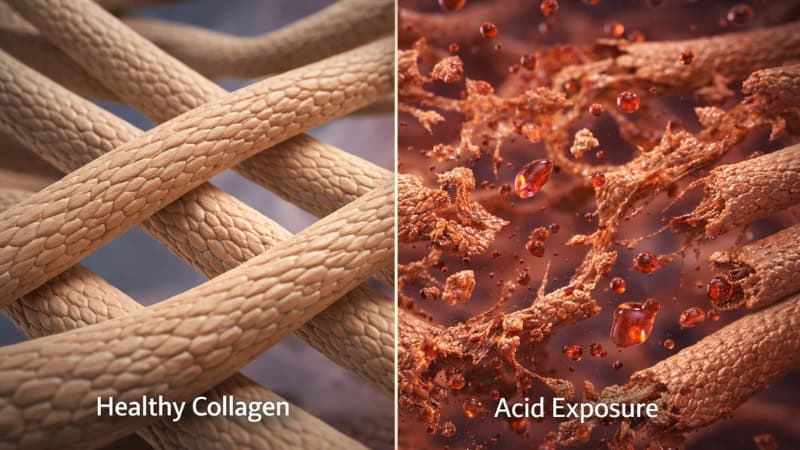
Understanding Leather: Why It’s Sensitive to Acidic Cleaners
Leather is not plastic. It’s a biologically derived material made primarily of collagen protein fibers. Its structure explains why acidic household cleaners can cause harm.
What Is Leather Made Of? (Collagen & Tanning Explained)
Leather begins as animal hide. Through tanning, the collagen matrix is stabilized, resisting decay and retaining flexibility.
Key structural elements:
Collagen fibers
- Provide tensile strength and flexibility.
- Interwoven protein structure.
- Sensitive to chemical shifts.
Tanning agents
- Chrome-tanned leather uses chromium salts.
- Vegetable-tanned leather uses plant tannins.
- Both rely on stable pH for longevity.
Protective finishes
- Pigmented topcoat
- Wax or polyurethane sealants
- These act as moisture and stain barriers.
When acidic substances disrupt this balance, the collagen network begins to weaken.
Leather’s Natural pH Balance
Leather is naturally slightly acidic. Its optimal pH range is 4.5-5.5, which helps maintain fiber flexibility, structural integrity, and resistance to premature degradation.
This mild acidity helps stabilize the collagen protein fibers formed during the tanning process. When leather stays within this range, its internal structure remains lubricated, resilient, and less prone to brittleness.
When exposed to stronger acids like vinegar (pH 2–3), the balance shifts downward. Even small but repeated shifts can destabilize the collagen matrix. Over time, this imbalance contributes to stiffness, fiber shrinkage, and loss of tensile strength.
Maintaining proper pH is not cosmetic — it is structural preservation.
Why Vinegar Ruins Leather Over Time
Vinegar damages leather gradually, not instantly. Its acidity disrupts collagen stability, strips essential oils, and weakens protective finishes with repeated exposure.
The deterioration is chemical before it becomes visible.
Acidic Breakdown of Collagen Fibers
Leather’s strength comes from tightly interwoven collagen fibers stabilized during tanning. Acid exposure can trigger mild acid hydrolysis, a reaction that weakens protein bonds.
As these bonds degrade, tensile strength decreases. The leather may look intact initially, but structurally, it becomes more prone to cracking at stress points like folds and seams.
Stripping of Natural Oils
Leather contains lubricating oils embedded during the tanning and conditioning process. These oils prevent internal fiber friction and keep the material supple.
Vinegar dissolves surface oils and accelerates moisture evaporation. Without lubrication, fibers rub against each other, increasing stiffness and accelerating dryness — a precursor to cracking.
Surface Discoloration and Dye Instability
Leather dyes rely on chemical stability to maintain even coloration. Acid exposure can destabilize pigments, especially in finished or pigmented leather.
This often appears as lightened patches, dullness, or uneven tone. Dark leather is particularly susceptible to visible fading.
Breakdown of Protective Finishes
Many leather goods — especially car seats and furniture — have polyurethane or wax-based protective coatings. These finishes create a barrier against moisture and stains.
Vinegar can degrade these coatings over time. Once compromised, the leather becomes more porous and more vulnerable to further chemical or environmental damage.
What Happens If You Use Vinegar on Leather Once?
A single diluted application rarely causes immediate catastrophic damage. However, the impact depends on concentration, leather type, and whether conditioning is applied afterward.
If vinegar is heavily diluted and wiped off quickly, the leather may only experience temporary dryness. In some cases, no visible change occurs.
Undiluted vinegar is more aggressive. It can cause mild stiffness, slight fading, or surface dullness within hours.
Unfinished leather — such as suede or nubuck — absorbs liquid rapidly. Even one application can alter the texture or leave visible marks.
The key issue is not one-time emergency use. It is repeated use without rebalancing and conditioning accelerates long-term deterioration.
Types of Leather Most Vulnerable to Vinegar Damage
Different leather types react differently based on porosity, finishing, and fiber exposure.
Full-Grain Leather
This is the most natural and minimally processed leather. Because it retains the full grain layer, it is more porous and absorbs liquids more readily.
Acid exposure can penetrate deeper into the fiber structure, increasing the risk of oil stripping and stiffness.
Top-Grain Leather
Top-grain leather has been sanded and finished. While the protective layer offers some resistance, repeated exposure to acids can degrade the coating over time.
Damage typically begins at the finish level before affecting deeper fibers.
Suede and Nubuck
These leathers are highly absorbent due to their textured surface. Liquids penetrate quickly and can alter both color and texture.
Vinegar can leave stiff patches or visible spotting, especially if it’s not applied evenly.
Bonded Leather
Bonded leather is made from shredded leather fibers held together with adhesives and synthetic binders. Acid exposure may weaken these binding agents.
This increases the risk of peeling and delamination.
Faux Leather (PU and PVC)
Faux leather does not contain collagen fibers. Vinegar will not cause protein breakdown, but it can dull synthetic coatings or reduce shine.
While less structurally vulnerable, it still benefits from manufacturer-recommended cleaners.
Why Vinegar Is Often Recommended (And Why That Advice Persists)
Vinegar gained popularity as a universal household cleaner long before modern leather chemistry was widely understood.
Older DIY guides promoted vinegar for:
- Mold removal
- Odor neutralization
- General disinfecting
Because vinegar is effective on hard surfaces, many assumed it was safe for leather as well.
However, leather is not a hard surface. It is a pH-sensitive protein-based material.
Modern leather care professionals emphasize a different approach:
- Use pH-balanced leather cleaners to maintain fiber stability.
- Follow cleaning with conditioning to replenish oils.
- Avoid routine use of acidic or alkaline household products.
The persistence of vinegar advice reflects outdated cleaning trends — not current material science.

Signs Vinegar Has Already Damaged Your Leather
Damage from vinegar often appears gradually rather than instantly.
You may first notice subtle texture changes. Over time, structural issues become more visible.
Common indicators include:
- Increased stiffness: The leather feels rigid or less flexible than before.
- Surface cracking: Fine lines develop, especially along folds or high-stress areas.
- Faded or blotchy color: Pigment may appear uneven or dull.
- Rough or chalky texture: Oil loss can leave the surface dry to the touch.
- Peeling finish: Protective coatings begin to flake or lift.
Early detection improves the likelihood of partial recovery through conditioning and restoration.
How to Fix Leather Damaged by Vinegar
Repair depends on severity. Minor dryness is easier to address than structural cracking.
Rebalance the Surface
Start by cleaning the leather with a pH-balanced leather cleaner. This helps stabilize the surface environment without introducing further acidity or alkalinity.
Avoid improvising with additional household solutions.
Restore Lost Moisture and Oils
Apply a high-quality leather conditioner containing emollients such as lanolin, natural oils, or beeswax.
Work it into the surface gently and allow it to absorb. Conditioning reduces stiffness and improves flexibility over time.
Reinforce the Protective Barrier
Once conditioned, apply a leather protectant suitable for the product type (shoes, upholstery, automotive leather).
This helps reduce future chemical and environmental stress.
Seek Professional Restoration (If Severe)
If cracking, peeling, or significant discoloration is present, consult a leather restoration specialist or professional cobbler.
Refinishing may involve recoloring, resealing, or structural reinforcement.
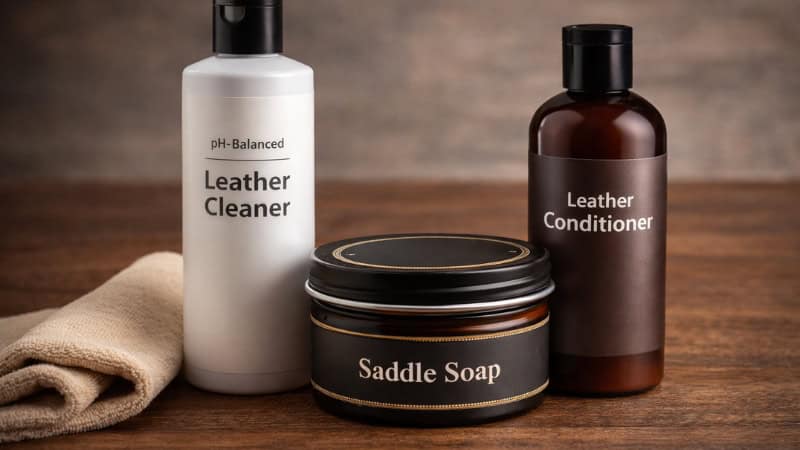
What to Use Instead of Vinegar on Leather
Safer alternatives preserve collagen integrity while maintaining cleanliness.
pH-Balanced Leather Cleaners
These are formulated specifically for leather’s pH range of 4.5–5.5. They clean without destabilizing fiber structure or stripping essential oils.
They are the safest choice for routine maintenance.
Saddle Soap (Used Appropriately)
Saddle soap is mildly alkaline but buffered for leather use. It should be applied sparingly and always followed by conditioning to prevent dryness.
Best suited for durable leather goods, such as boots or saddlery.
Mild Soap and Water (Diluted)
A highly diluted solution of gentle soap can work for minor spot cleaning. Always test on a hidden area first and avoid over-saturation.
This is a short-term solution, not a long-term maintenance strategy.
Commercial Leather Conditioning Products
Commercial leather conditioners are designed to replenish oils lost through daily wear and environmental exposure.
They do more than clean — they restore lubrication within collagen fibers, improve flexibility, and extend the lifespan of leather goods.
Unlike vinegar, these products are formulated around leather chemistry rather than general household cleaning principles.
| Cleaner Type | Approx. pH | Safe for Routine Use? | Long-Term Impact |
| Vinegar | 2–3 | No | Fiber weakening |
| pH-balanced cleaner | 4.5–5.5 | Yes | Preserves structure |
| Saddle soap | 7–8 | Occasionally | Safe if conditioned |
| Mild soap solution | 6–7 | Limited use | Generally safe |
Frequently Asked Questions
Can Vinegar Permanently Damage Leather?
Yes, vinegar can permanently damage leather if used repeatedly or at a high concentration. Its acidity (pH 2–3) disrupts leather’s natural pH balance, weakens collagen fibers, and strips essential oils. While minor exposure may only cause temporary dryness, ongoing use can lead to irreversible cracking, discoloration, and finish deterioration.
Does White Vinegar Ruin Leather Shoes?
White vinegar can ruin leather shoes over time, especially when used as a regular cleaner. It removes natural oils that maintain flexibility, causes stiffness in high-crease areas, and may dull or fade dyes. Occasional diluted use may not show immediate damage, but repeated application accelerates aging.
Can Vinegar Remove Mold from Leather Safely?
Vinegar can kill surface mold, but it is not the safest solution for leather. Although acetic acid has mild antimicrobial properties, it can also disturb the collagen structure and dry out the material. Mold removal is better handled with controlled drying, gentle cleaning, and leather-safe, pH-balanced products.
How Long Does It Take for Vinegar to Damage Leather?
Vinegar typically damages leather gradually rather than instantly. A single diluted use may only cause mild dryness, but repeated exposure over time weakens fibers, strips oils, and increases brittleness. The speed of damage depends on leather type, concentration used, and whether conditioning follows.
Is Diluted Vinegar Safe for Leather Couches?
Diluted vinegar is not recommended for routine cleaning of leather couches. Even when diluted, repeated use can degrade polyurethane finishes, reduce surface protection, and dry out underlying fibers. For upholstery, manufacturers generally recommend pH-balanced leather cleaners followed by conditioning.
What Happens If You Don’t Condition Leather After Using Vinegar?
If leather is not conditioned after vinegar use, the natural oils removed during cleaning are not replenished. This increases dryness, internal fiber friction, and brittleness, which can eventually lead to surface cracking and loss of flexibility.
Is Vinegar Worse Than Soap for Leather?
Yes, vinegar is generally harsher than mild diluted soap because of its stronger acidity. Mild soap solutions sit closer to neutral pH and are less disruptive to collagen fibers when properly diluted and rinsed. However, both should be followed by conditioning to maintain leather health.
Can Vinegar Cause Leather to Crack?
Yes, vinegar can contribute to leather cracking over time. By weakening collagen bonds and stripping lubricating oils, it reduces flexibility and increases stress on fold areas, eventually leading to visible cracks and structural deterioration.
Final Verdict — Should You Ever Use Vinegar on Leather?
Vinegar is not the safest choice for leather care.
While diluted vinegar may not cause immediate destruction, repeated use disrupts pH balance, strips oils, weakens collagen fibers, and accelerates aging.
If longevity matters — especially for leather shoes, furniture, car seats, or bags — stick to pH-balanced leather care products.
Leather is an investment. Treat it according to its chemistry—not general household-cleaning advice.