
Leather cracks near radiators because constant heat exposure dries out its natural oils, reducing indoor humidity. When moisture evaporates from leather fibers, the material becomes stiff, brittle, and prone to splitting.
Radiator heat accelerates this process by creating a low-humidity microclimate around furniture — especially leather sofas, chairs, and upholstery placed too close to heating systems.
Understanding why leather dries out near heaters helps you prevent irreversible cracking and extend your furniture’s lifespan.
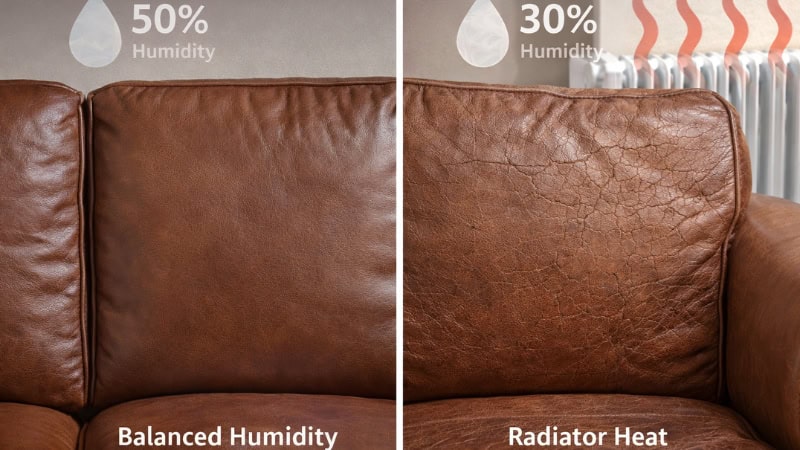
What Happens to Leather When Placed Near a Radiator?
Leather is a natural material made from animal hide, composed primarily of collagen fibers and natural oils. When exposed to radiator heat, it loses moisture faster than it can replenish it. Over time, this leads to fiber dehydration, surface tension, and visible cracking.
Here’s what physically happens:
- Moisture Evaporation Increases: Radiators emit dry convective heat. This lowers relative humidity around the furniture, accelerating water loss from the leather structure.
- Natural Oils Begin to Deplete: Leather relies on oils to remain flexible. Heat speeds up oil evaporation, causing stiffness and dullness.
- Collagen Fibers Contract & Weaken: As hydration levels drop, collagen bundles shrink. This creates internal stress that eventually leads to microcracks.
- Surface Finish Becomes Brittle: Protective coatings on top grain or aniline leather can harden and fracture under prolonged heat exposure.
In real-world upholstery assessments, leather placed directly beside radiators often shows premature aging compared to identical pieces placed in stable-humidity zones.
If you’re new to long-term leather maintenance, our broader Leather Furniture Care Guide explains how environmental conditions affect durability year-round.
Why Does Radiator Heat Cause Leather to Crack Faster Than Normal Aging?
Normal leather aging is gradual. Radiator heat compresses years of wear into a single winter season. The difference lies in humidity control, oil retention, and thermal stress cycles.
Low Indoor Humidity & Moisture Loss
Central heating systems can reduce indoor humidity below 30% during winter. Leather performs best between 40–60% relative humidity.
When humidity drops:
- Water molecules exit the leather matrix
- Fiber flexibility decreases
- Surface tension increases
Dry indoor air acts like a slow dehydration chamber for upholstery.
Accelerated Oil Evaporation
Leather contains lubricating oils from the tanning process. Radiator heat speeds up their evaporation.
Without sufficient oil content:
- Leather loses elasticity
- Creasing deepens
- Cracks form at stress points (armrests, seat cushions)
This is why leather sofas near heaters often crack at corners first.
Shrinkage & Uneven Heat Stress
Radiators create localized hot spots.
Uneven heating leads to:
- Surface contraction
- Micro-fractures
- Separation in coated finishes
Unlike natural aging, radiator damage is concentrated and directional — typically on the side facing the heater.
Types of Leather Most Vulnerable to Radiator Damage
Not all leather responds to radiator heat in the same way. The level of vulnerability depends on grain quality, surface coating, porosity, tanning method, and structural composition. Understanding what type of leather your sofa or chair is made from helps predict how quickly moisture loss, oil depletion, and cracking may occur near heating systems.
Below is how different leather types react to prolonged radiator exposure.
Aniline Leather: Highly Porous and Heat Sensitive
Aniline leather is one of the most natural-looking and breathable types of leather. It is dyed with soluble dyes and typically has little to no protective topcoat. Because of this minimal surface treatment, it retains its natural texture — but it also remains highly porous.
When placed near a radiator, aniline leather absorbs and releases moisture quickly. This means it dehydrates faster in low-humidity environments created by central heating systems. Without a protective barrier, moisture evaporation accelerates, and natural oils dissipate more rapidly. The result is early-stage dryness, visible dullness, and eventually fine surface cracks.
Aniline leather offers premium aesthetics but requires strict humidity control and consistent conditioning if positioned in heated rooms.
Full Grain Leather: Durable but Not Immune
Full grain leather is considered one of the strongest and most durable leather types because it retains the entire grain layer. Its dense collagen fiber structure provides better resistance to wear compared to corrected or split leather.
However, radiator heat still affects full grain leather over time. While it may not crack as quickly as aniline leather, prolonged exposure to low humidity leads to gradual fiber dehydration. The material can stiffen, especially along armrests and panels facing the heat source. Cracking typically appears after extended dryness rather than rapidly.
Full grain leather tolerates environmental stress better than most, but it is not immune to moisture imbalance.
Top Grain Leather: Moderately Protected but Vulnerable
Top grain leather is sanded and treated to remove imperfections, then finished with a protective coating. This surface layer offers some resistance to stains and moisture loss, making it slightly more resilient to environmental changes than aniline leather.
Despite the coating, radiator heat can cause the finish to harden over time. As the underlying leather loses moisture, tension builds beneath the surface layer. This often leads to micro-fractures in the finish before deeper cracks form in the hide itself.
In heated rooms, top grain leather may initially appear unaffected, but subtle stiffness and surface brittleness signal early heat stress.
Bonded Leather: Adhesive Weakening and Peeling Risk
Bonded leather is made from shredded leather fibers combined with polyurethane binders and pressed into sheets. It contains a smaller percentage of genuine leather compared to full or top grain varieties.
Radiator heat does not primarily dry out bonded leather the way it does natural hide. Instead, it weakens the adhesives that hold the material together. Over time, heat exposure causes delamination, bubbling, and peeling — especially on surfaces closest to the radiator.
Because bonded leather relies on synthetic bonding agents, once peeling begins, restoration options are limited.
Faux Leather (PU & Vinyl): Plasticizer Evaporation
Faux leather, including polyurethane (PU) and vinyl, is entirely synthetic. It does not contain collagen fibers or natural oils. However, it still reacts negatively to prolonged radiator exposure.
Heat causes plasticizers — the compounds that keep synthetic leather flexible — to evaporate gradually. As flexibility decreases, the material stiffens and becomes prone to cracking or flaking. Additionally, thermal stress can warp seams and cause surface separation from the backing fabric.
Unlike genuine leather, faux leather damage appears more as surface splitting and peeling rather than deep fiber cracking.
Split Leather & Corrected Grain: Surface Coating Stress
Split leather and corrected grain leather undergo heavy finishing and coating processes. While these finishes provide aesthetic uniformity, they can become brittle under continuous dry heat.
Radiator exposure often causes the protective coating to crack first. Once the coating fractures, moisture loss accelerates in the exposed layers beneath. This creates a compounding effect where cosmetic damage quickly becomes structural.
Which Leather Type Is Most at Risk?
In environments with radiators:
- Aniline leather is most vulnerable due to high porosity.
- Bonded leather is prone to peeling and delamination.
- Faux leather risks surface cracking from plasticizer loss.
- Top grain and full grain leather show slower but still significant dehydration over time.
Regardless of type, all leather benefits from humidity stability and proper placement away from direct heat sources.
Identifying your leather type allows you to tailor preventive care strategies — especially in rooms with active central heating systems.
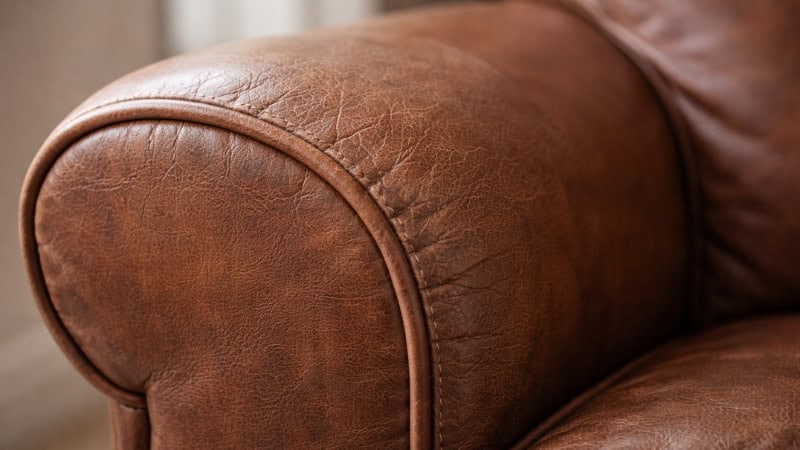
Early Warning Signs of Heat-Damaged Leather
Radiator damage develops gradually. Identifying early symptoms allows you to intervene before structural cracking occurs.
Heat-damaged leather typically shows changes in texture, elasticity, color stability, and surface integrity.
Watch for these signs:
- Surface Dryness: The leather feels rough or papery, rather than soft and supple.
- Loss of Flexibility: When pressed, the material resists movement instead of rebounding naturally.
- Uneven Fading: The side facing the radiator appears lighter or duller.
- Fine Hairline Cracks: Small fissures appear at stress points, such as armrests or seat cushions.
- Increased Creasing: Normal creases become sharper and deeper due to stiffness.
- Peeling or Flaking (Coated Leather): Especially common in bonded or PU leather exposed to direct heat.
Early-stage dryness is reversible. Visible cracking indicates deeper fiber dehydration.
Safe Distance Between Leather & Radiators
How Close Is Too Close? Leather furniture should never sit directly beside or in front of a radiator.
Recommended minimum safe distance: 12–24 inches (30–60 cm). This buffer reduces localized heat concentration and slows moisture evaporation from leather fibers.
Why distance matters:
- Radiators create thermal hotspots directly in front of them.
- Airflow from convection heating concentrates dryness in a narrow zone.
- Continuous heat exposure causes uneven shrinkage on one side of the furniture.
Additional placement best practices:
- Avoid positioning leather between a radiator and a cold window (thermal contrast increases stress).
- Install radiator deflectors to redirect airflow upward.
- Rotate furniture seasonally if space is limited.
- Monitor humidity levels near the furniture, not just room-wide.
If maintaining distance is impossible, humidity control becomes essential.
Can Cracked Leather Be Repaired After Radiator Damage?
Repairability depends on severity. Radiator heat causes varying levels of damage — from surface dryness to structural fiber splits. The deeper the collagen damage, the harder full restoration becomes.
1. Mild Surface Dryness (Highly Repairable)
At this stage, leather structure is intact but dehydrated. Treatment includes:
- Gentle cleaning with pH-balanced leather cleaner
- Application of lanolin-based leather conditioner
- Controlled humidity restoration (40–60%)
Consistency matters more than product quantity. Over-conditioning can clog pores.
2. Surface Cracks (Moderately Repairable)
Visible cracks indicate fiber stress but not full structural failure.
Options include:
- Leather filler compounds
- Color-matching restoration creams
- Protective sealing after repair
These repairs improve appearance but may not fully restore elasticity.
3. Deep Splits & Structural Damage (Limited Repairability)
If collagen fibers are fully separated:
- Fillers provide cosmetic correction only.
- Upholstery professionals may need to patch or replace panels.
- Severe shrinkage often requires section replacement.
In many cases, heavily heat-damaged bonded leather cannot be effectively restored.
How to Prevent Leather Cracking Near Radiators
Preventing leather from cracking near radiators comes down to controlling humidity levels, heat exposure, and oil balance. Since radiator damage is environmental, the solution is environmental too. With the right adjustments, most heat-related leather cracking is entirely avoidable.
Maintain Stable Indoor Humidity (40–60%)
Leather performs best in environments where relative humidity stays between 40% and 60%. During winter, central heating systems often reduce humidity below 30%, which accelerates moisture evaporation from collagen fibers. Using a humidifier during colder months restores balance and prevents the leather from drying out internally. A simple hygrometer placed near the furniture gives more accurate readings than relying on general room estimates.
Humidity control protects not only the leather surface but also its internal fiber structure — which determines long-term flexibility and durability.
Condition Leather Before It Feels Dry
Conditioning should be proactive, not reactive. Waiting until leather feels stiff means dehydration has already begun. Applying a pH-balanced, oil-based leather conditioner every 3–6 months replenishes natural oils lost through heating cycles.
Focus especially on areas closest to radiators, such as armrests and side panels. These zones lose moisture faster due to direct heat exposure. Proper conditioning maintains elasticity, reduces tension stress, and prevents micro-cracks from forming.
Avoid silicone-heavy or household products, as they can seal the surface without restoring internal flexibility.
Optimize Furniture Placement
Distance from heat sources plays a critical role in preventing radiator damage. Leather furniture should ideally sit at least 12–24 inches away from radiators to reduce concentrated heat exposure.
If space is limited, reposition the furniture slightly off-center from the radiator rather than directly facing it. Even a small adjustment reduces thermal stress. Rotating cushions periodically also distributes exposure evenly, preventing one-sided shrinkage and fading.
Environmental consistency matters more than occasional high heat. Continuous mild exposure causes more long-term damage than short bursts.
Reduce Direct Heat Flow
Radiators emit convective airflow that rises upward. Installing a heat deflector redirects this airflow away from leather surfaces and toward the center of the room. This simple adjustment reduces the creation of a dry microclimate around the furniture.
In rooms with aggressive heating systems, temporarily lowering radiator output during peak winter months can significantly reduce stress on leather upholstery.
Protect Leather During Heavy Heating Seasons
During extended cold periods, leather benefits from added protection. Using breathable covers prevents direct exposure to heated air while still allowing ventilation. Avoid plastic or airtight materials, as they trap moisture unevenly and may create surface damage.
Preventive care during winter months is far more effective than repairing cracked leather later.
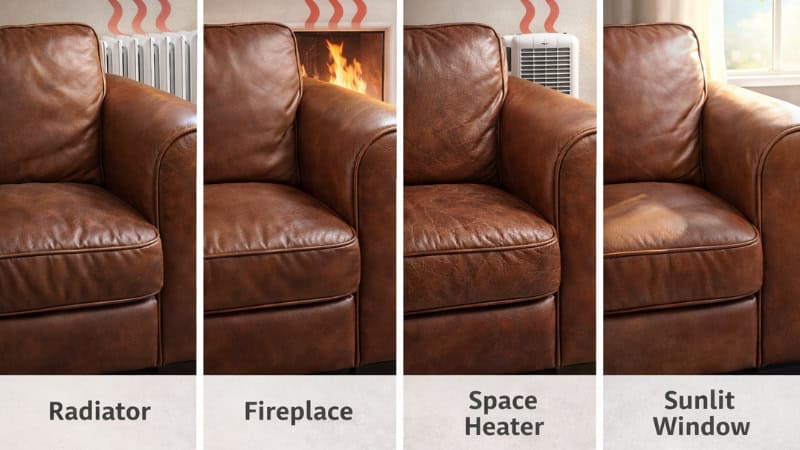
Radiators vs Other Heat Sources
Radiators are a common cause of leather cracking, but they are not the only heat source that affects upholstery. Different heating systems create different stress patterns on leather furniture.
Understanding these differences helps you adjust placement and care strategies accordingly.
Radiators – Consistent Dry Convective Heat
Radiators generate steady, dry heat that lowers surrounding humidity. Because they often operate for long periods during winter, they create continuous moisture loss in nearby leather. The damage is typically localized — appearing first on the side facing the heater.
The combination of proximity and low humidity makes radiators one of the most common causes of uneven leather cracking.
Fireplaces – Radiant Heat + Low Humidity
Fireplaces produce radiant heat rather than convective airflow. This heat is directional and can warm leather surfaces quickly. In addition, fireplaces reduce indoor humidity and may introduce soot particles into the air.
Leather positioned too close to a fireplace can experience surface drying and discoloration simultaneously. While less constant than radiators, the heat intensity can be stronger during use.
Space Heaters – High-Intensity Localized Airflow
Portable space heaters often pose a greater risk than central radiators. They produce concentrated hot airflow directed toward specific areas. When placed close to leather furniture, they can create extreme localized dryness within hours.
Because they are frequently moved and positioned at close range, space heaters can cause faster cracking than fixed heating systems.
Underfloor Heating – Subtle but Continuous Drying
Underfloor heating distributes warmth more evenly across a room. While it does not usually create localized hot spots, it can gradually reduce overall humidity levels during winter months.
Leather exposed to prolonged low humidity from underfloor heating may show slow, uniform dryness rather than concentrated cracking. Humidity monitoring becomes particularly important in these environments.
Combined Heat & UV Exposure – The Highest Risk Scenario
When radiator heat or fireplace warmth combines with direct sunlight, the risk increases significantly. UV radiation causes oxidation and color fading, while heat accelerates moisture loss.
This dual exposure weakens collagen fibers faster than heat alone. Leather placed between a radiator and a window is especially vulnerable due to thermal contrast and UV stress.
Expert Tips From Leather Care Specialists
Professionals who repair upholstery consistently observe patterns in heat-damaged leather.
Based on real-world restoration work:
- Most radiator-related cracking appears on one side first.
- Damage accelerates during winter heating seasons.
- Conditioning is often applied too late — after cracks appear.
- Indoor humidity below 35% significantly increases risk.
Specialist Recommendations:
- Monitor humidity before visible dryness.
- Condition proactively at the start of winter.
- Avoid placing newly purchased leather furniture near radiators during its first year.
- Never use household cleaners on heat-damaged leather.
- Use leather-specific care products only.
Leather durability is environmental. Stable temperature and humidity dramatically extend lifespan.
When leather furniture is kept away from direct heating systems and properly conditioned, cracking near radiators is largely preventable.
FAQs – Why Leather Cracks Near Radiators
Is radiator heat bad for leather sofas?
Yes. Radiator heat lowers humidity and accelerates oil evaporation, causing leather to stiffen and crack over time.
Can dry leather be restored?
Mild dryness can be improved with proper conditioning. Severe cracking requires repair fillers or professional restoration.
Why does leather peel near heaters?
Heat weakens surface coatings and adhesives, especially in bonded or faux leather, leading to peeling.
Does cold weather damage leather too?
Cold itself is not the issue. Low humidity from heating systems causes most winter leather damage.
How do you rehydrate leather furniture?
Clean gently, apply a pH-balanced conditioner, maintain 40–60% humidity, and avoid direct heat exposure.
Final Thoughts: Protecting Leather Furniture From Heat Damage
Leather cracking near radiators is preventable. The core causes are moisture loss, oil depletion, and fiber contraction triggered by localized heat and low humidity.
Maintaining stable humidity, smart placement, and consistent conditioning will significantly extend leather lifespan. For a complete environmental care strategy, review the full Leather Furniture Care framework to ensure long-term durability.
