
Leather has a way of telling stories—of rides taken, miles endured, seasons survived. But when that familiar surface suddenly develops white patches, it feels less like character and more like damage. Riders often mistake these marks for simple dust or aging, only to realize the problem keeps recurring.
Here’s where things get tricky: not all white residue on leather is the same. Sometimes it’s mold quietly feeding on moisture and neglect. Other times, it’s salt—drawn out from within or deposited from sweat and the road. Treat one like the other, and you risk making things worse, not better.
This guide breaks down exactly why leather turns white, how to tell mold from salt, and what your gear is really trying to tell you before it starts to break down for good.
Understanding Leather Structure
Leather isn’t just a surface—it’s a living memory of organic structure, reshaped but never fully stripped of its nature. To understand why it turns white, you need to understand how it breathes, absorbs, and reacts.
Leather as a Porous, Living Matrix
At its core, leather is made of tightly interwoven collagen fibers, forming a structure that behaves almost like a sponge with memory. Even after tanning, those fibers retain a porous architecture, meaning they constantly interact with their environment—absorbing moisture, releasing it, and reacting to whatever travels with it.
From a rider’s perspective, this is why your gloves feel different after a humid ride versus a dry one. The leather isn’t passive—it’s adapting, swelling slightly with moisture and contracting as it dries.
Moisture Absorption & Hygroscopic Behavior
Leather exhibits hygroscopic behavior, meaning it naturally pulls in water vapor from the air. When relative humidity rises above comfortable levels, those collagen fibers begin to hold onto excess moisture.
That moisture becomes a carrier. It brings along salts from sweat, residues from the tanning process, and sometimes airborne contaminants. As conditions shift—heat, airflow, drying cycles—those substances don’t just disappear. They migrate.
This constant push-and-pull between absorption and evaporation is what sets the stage for white residue to appear. Whether it manifests as mold or salt depends on what’s traveling through the leather—and how long it stays there.
The Two Main Causes of White Residue
White patches on leather aren’t random—they’re signals. And most of the time, they point to one of two culprits working beneath the surface.
Mold vs Salt: Two Different Stories on the Same Surface
At first glance, both mold and salt residue can look deceptively similar—pale, dusty, almost harmless. But they come from entirely different processes.
Mold (mildew) is biological. It feeds, grows, and spreads when moisture lingers too long in the leather. It’s alive, and like rust on metal, it signals ongoing damage.
Salt bloom (efflorescence), on the other hand, is chemical. It’s the result of hygroscopic salts—like sodium chloride—being drawn to the surface through moisture movement. When the water evaporates, the salts stay behind, forming that familiar white haze.
Why Misidentification Costs You
Treat salt like mold, and you risk over-cleaning or damaging the leather. Treat mold like salt, and you leave a living problem behind.
In the saddle—or off it—this distinction matters. Because what looks like a minor cosmetic issue can quietly turn into structural damage if misunderstood.
Cause #1: Mold (Mildew) on Leather
Mold doesn’t arrive with noise—it creeps in quietly, settling into leather the same way dampness settles into an old garage after rain. And once it finds a foothold, it doesn’t just sit there—it feeds.
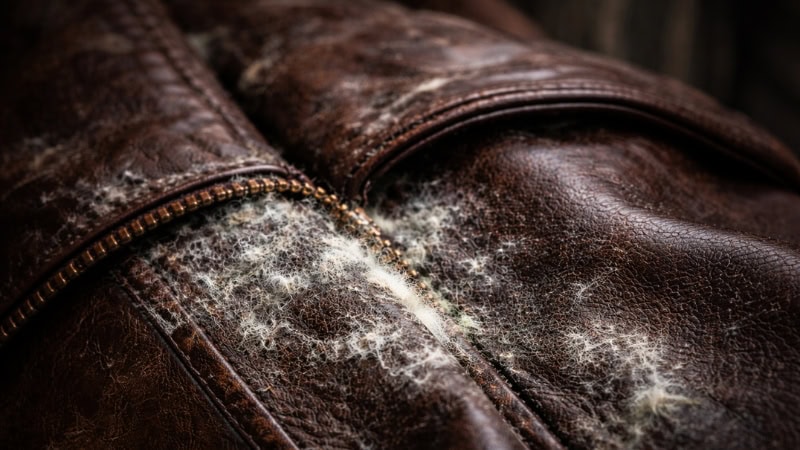
What is Leather Mold?
Mold on leather is a form of fungal growth, made up of microscopic mildew spores that exist almost everywhere in the environment. On their own, they’re harmless. But give them moisture, warmth, and an organic surface like leather—and they come alive.
Leather, rich in natural proteins and oils, becomes an ideal host. Those collagen fibers you rely on for durability? Mold sees them as a food source.
From experience, this is why neglected riding gear—left in a damp locker or packed away after a wet ride—often becomes ground zero for mildew.
Why Mold Appears
Mold doesn’t need much—just the right conditions for long enough.
Humidity is the main trigger. Once relative humidity exceeds 60%, leather begins to retain moisture rather than releasing it efficiently. That trapped dampness creates a stable environment for spores to germinate.
Add in poor airflow—like a zipped-up jacket in a humid room—and you’ve essentially built a greenhouse for mold.
Sweat plays its part too. It leaves behind organic residues that act like nutrients, accelerating fungal growth. In riding terms, that means your most-used gear is often the most vulnerable if not properly dried.
How to Identify Mold
Mold has a presence—you can usually sense it before you fully see it.
It often appears as a fuzzy or slightly raised white layer, sometimes with hints of green or gray. Unlike salt, it doesn’t sit flat—it spreads, branching outward in irregular patterns.
But the real giveaway is the smell. A musty, damp odor—like old fabric left too long in a closed space—is almost always mold announcing itself.
Run your fingers lightly over it, and it may smear or feel soft rather than dry and chalky.
Risks of Mold
Mold isn’t just cosmetic—it’s corrosive in its own biological way.
Over time, it breaks down the leather’s internal structure, weakening those collagen bonds. What starts as surface spotting can evolve into cracking, stiffness, and irreversible damage.
And then there’s the human side. Prolonged exposure to mildew spores can irritate the respiratory system—especially in enclosed spaces.
For a rider, that means mold isn’t just about saving gear—it’s about maintaining something that’s supposed to protect you.
Cause #2: Salt Bloom (Efflorescence)
Salt bloom doesn’t creep in like mold—it reveals itself. Like dried sweat lines on a long ride, it’s the mark of something that traveled through the leather and got left behind.
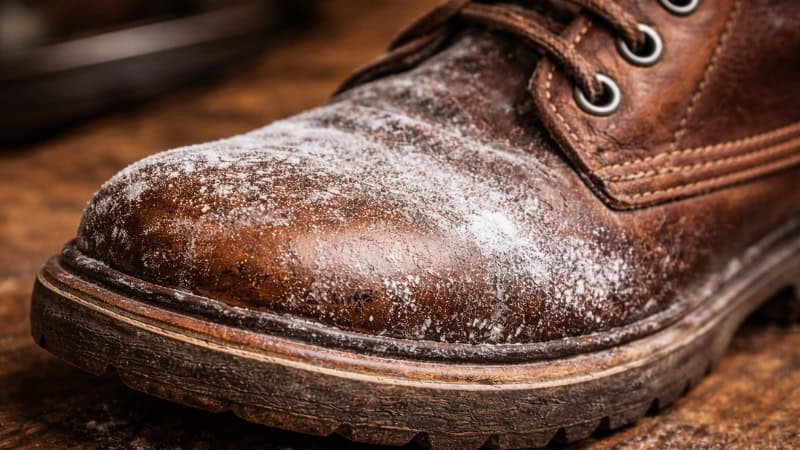
What is Salt Bloom?
Salt bloom, technically known as efflorescence, is the process by which hygroscopic salts migrate from within the leather to its surface. These salts—often sodium chloride or residues from the tanning process—dissolve in moisture and move through the leather’s porous network.
When that moisture evaporates, the salts crystallize on the surface, forming a white, dusty film.
From a rider’s lens, think of it like mineral deposits left on your visor after a long ride through mist—except this time, it’s happening inside your gear.
Why It Happens
Salt bloom is driven by moisture movement—specifically, through leather.
When leather absorbs water—whether from humidity, rain, or sweat—it creates a pathway. Through capillary action, dissolved salts are pulled outward along with that moisture. Once the surface dries, the water evaporates, leaving the salts behind.
This is why salt bloom often appears after cycles:
- Wet → Dry → White residue
- Clean → Dry → Residue returns
Sweat is a major contributor here. Long rides, especially in heat, load leather with sodium chloride, which later resurfaces. Road salt can also play a role, particularly on boots and lower gear exposed to splashes.
Even newly manufactured leather can show efflorescence if residual salts weren’t fully stabilized during processing.
How to Identify Salt Residue
Salt bloom is subtle but consistent—it behaves differently from anything alive.
It appears as a flat, powdery, chalk-like layer, usually bright white and evenly distributed. Unlike mold, it doesn’t grow outward in patterns—it settles.
There’s no smell. No softness. Just dryness.
Wipe it gently with a damp cloth, and it often disappears instantly. But here’s the catch—it may come back. That’s because the source isn’t on the surface; it’s inside the leather.
Common Sources of Salt
Salt bloom isn’t random—it’s tied to exposure and use.
Sweat is the most common source, especially in gloves, jackets, and seat-contact areas. Every ride leaves microscopic traces that build up over time.
Environmental exposure matters too. Riding through winter-treated roads introduces external salts that soak into leather footwear and gear.
Then there’s the tanning process itself. If leather retains excess mineral content, efflorescence can occur even without heavy use.
In short, salt bloom is less about neglect and more about accumulation—quiet, repeated, and inevitable without proper care.
Mold vs Salt: Key Differences
At a glance, mold and salt can fool even experienced riders. But once you know what to look for, the difference becomes as clear as dry asphalt versus black ice.
Surface Behavior & Texture Differences
Mold has dimension—it rises, spreads, and evolves. Its texture is often fuzzy or soft, sometimes uneven, like a patch of fine dust that refuses to sit still.
Salt, on the other hand, is static. It forms a dry, powdery layer that sits flat against the leather, almost like a thin chalk coating.
One grows. The other settles.
Smell, Spread & Risk Profile
Mold announces itself through smell—a musty, damp odor that lingers even after surface cleaning. It spreads over time, feeding on the leather and anything organic it finds.
Salt has no scent. No growth pattern. It doesn’t spread—it reappears.
But here’s the critical divide:
Mold is destructive and alive. Salt is cosmetic but persistent.
Misreading this is like treating engine noise as wind resistance—you’ll fix the wrong problem and miss the real one.
How to Remove Mold from Leather
Removing mold isn’t just cleaning—it’s intervention. You’re not wiping dirt; you’re stopping something that’s actively feeding on your gear.
Initial Containment & Drying
Start by isolating the item. Take it outdoors or into a well-ventilated space—this isn’t just for airflow, but to avoid spreading mildew spores indoors.
Let the leather dry naturally. No heat guns, no direct sunlight. Rapid drying can stiffen and crack the surface, especially if moisture is trapped deeper inside.
Think of it like cooling down an engine—you don’t shock it, you let it settle.
Surface Cleaning & Spore Removal
Once dry, gently brush off visible mold using a soft brush or cloth. This removes loose colonies before applying any liquid.
For deeper cleaning, use a diluted solution of isopropyl alcohol or white vinegar. Lightly dampen a cloth—not soak—and wipe the affected areas.
This step is less about scrubbing and more about neutralizing. You’re breaking down the fungal presence without overwhelming the leather.
Avoid over-saturation. Leather remembers water.
Restoration & Conditioning
After cleaning, the leather will feel slightly stripped—because it is. Mold and cleaning agents both disrupt natural oils.
Apply a quality leather conditioner to restore flexibility and balance. This step is crucial. Skip it, and you trade mold damage for dryness and cracking.
Let the leather rest, absorb, and stabilize.
Preventing Mold Recurrence
Mold rarely comes once—it returns if conditions allow.
Store leather in environments where relative humidity stays between 40–55%. Use airflow, avoid sealed plastic storage, and ensure gear is fully dry before putting it away.
From a rider’s standpoint, this is routine maintenance—like chain lubrication or tire checks. Ignore it, and problems don’t just come back—they escalate.
How to Remove Salt Residue from Leather
Salt doesn’t need to be killed—it needs to be drawn out and balanced. The trick isn’t force; it’s patience and repetition, like easing tension out of a stiff saddle rather than forcing it flat.
Dissolving Surface Salt Safely
Start with a slightly damp cloth, ideally using distilled water. Tap water can carry minerals that complicate things, especially on already sensitive leather.
Gently wipe the affected area. You’re not scrubbing—you’re reactivating the salt crystals so they dissolve back into moisture and lift away.
The white film often disappears instantly. But don’t mistake that for completion.
Salt bloom is rarely just surface-level. It’s a cycle. What you remove today may reappear tomorrow if deeper salts are still migrating outward.
Deep Cleaning & Rebalancing
If residue returns, introduce a mild, pH-balanced leather cleaner. This helps break the cycle by stabilizing the leather’s internal moisture balance.
Apply sparingly, working in small sections. Over-wetting leather is like over-revving a cold engine—it causes more stress than progress.
Repeat the process over a few sessions if needed. Salt removal is rarely a one-pass job.
Conditioning After Salt Removal
Once the surface is clear, conditioning becomes non-negotiable.
Salt strips moisture. Cleaning strips oils. Left untreated, the leather dries out, stiffens, and eventually cracks.
Apply a quality leather conditioner to restore flexibility and resilience. Let it absorb slowly—this is recovery, not a quick fix.
Prevention: Keeping Leather from Turning White (≈330 words)
Prevention isn’t glamorous, but it’s what keeps leather from telling the same story twice. Once you’ve dealt with mold or salt, the goal shifts—from fixing damage to controlling the environment that caused it.
Managing Humidity & Storage Conditions
Leather thrives in balance. Too dry, it cracks. Too humid, it invites mold and salt migration.
Keep storage environments within 40–55% relative humidity. Use silica gel packs or a dehumidifier if needed, especially in monsoon-heavy or coastal climates.
Avoid sealing leather in plastic. It traps moisture like a closed helmet after a long ride—everything inside starts to sour.
Airflow matters. A well-ventilated space does more for leather than any product ever will.
Post-Use Care: Sweat & Moisture Control
Every ride leaves a trace.
Sweat introduces sodium chloride, and moisture carries it deep into the leather. If gear is stored immediately after use—still damp, still warm—you’re setting up both mold and salt bloom.
Let your gear breathe. Hang it. Open it. Give it time to release what it absorbed.
From a rider’s perspective, this is cooldown protocol. You don’t park hot and forget—you stabilize first.
Routine Conditioning & Maintenance
Conditioning isn’t just cosmetic—it’s structural.
Regular use of a leather conditioner keeps fibers flexible and less prone to absorbing excess moisture. It creates a controlled barrier, reducing how deeply salts and water penetrate.
But moderation matters. Over-conditioning can clog pores and disrupt natural breathability.
Think of it like tuning suspension—you adjust, not overload.
Consistency beats intensity here.
FAQs on Why Leather Turns White
Is white residue on leather always mold?
No—and this is where most people go wrong.
White residue can be either mold (biological) or salt bloom (chemical). Mold will usually have a musty smell and a slightly fuzzy texture, while salt appears dry, powdery, and odorless.
Misidentifying the two often leads to the wrong treatment—and recurring problems.
Can salt permanently damage leather?
Salt itself isn’t aggressive, but over time, it disrupts moisture balance.
Repeated salt buildup can dry out leather, leading to stiffness and surface cracking if not properly cleaned and conditioned. The damage is gradual—but very real.
Is leather mold dangerous?
Mold is more than a surface issue.
Beyond damaging leather, mildew spores can affect air quality, especially in enclosed spaces. For riders storing gear indoors, this becomes both a material and a health concern.
Can I use household cleaners on leather?
Not recommended.
Many household cleaners are too harsh or improperly balanced for leather’s pH and organic structure. They may remove stains temporarily, but cause long-term damage.
Stick to leather-specific or gentle solutions, such as diluted alcohol or vinegar, when necessary.
Why does white residue keep coming back after cleaning leather?
Recurring white residue usually points to salt bloom (efflorescence) rather than mold.
Salts trapped inside the leather continue to migrate outward with moisture cycles. Even after cleaning the surface, deeper salts resurface as the leather dries. Repeated gentle cleaning and proper conditioning help break this cycle over time.
Can humidity alone cause white spots on leather?
Humidity by itself doesn’t create residue—but it enables both mold and salt bloom.
High relative humidity allows mold to grow and also activates the movement of hygroscopic salts within leather. Without moisture, neither process fully develops, which is why climate control is key to prevention.
Final Take: Reading What Your Leather Is Trying to Tell You
Leather doesn’t fail without warning—it signals. White patches are one of those signals, whether they come from living mold or silent salt rising to the surface.
Knowing the difference changes everything. It’s the difference between stopping damage early and letting it settle deep into the structure.
For riders, leather isn’t just a material—it’s protection, memory, and performance. Treat it accordingly.
Keep it dry, let it breathe, and maintain it with intention. Because when leather is cared for properly, it doesn’t just last—it evolves, carrying every mile without breaking down along the way.
