
Saddle stitching is widely considered the strongest and most reliable hand-sewing method used in leathercraft. Unlike machine stitching, which uses a single thread that can unravel if broken, saddle stitching uses two needles working through the same hole from opposite directions. This technique creates a durable lock within every stitch, making it extremely resistant to wear and tear.
Leatherworkers rely on saddle stitching to produce long-lasting products such as wallets, belts, bags, knife sheaths, and saddlery. Because each stitch is independent, even if one section of thread fails, the rest of the seam remains intact.
In this complete guide, you will learn what saddle stitching is, the essential leatherworking tools required, how to prepare leather properly, and the exact step-by-step technique professionals use to achieve clean and durable stitches.
What Is Saddle Stitching in Leathercraft?
Before learning the technique, it helps to understand why saddle stitching is considered the gold standard of hand-sewing in leatherwork. This section explains the method, its structural strength, and its common uses.
Definition of Saddle Stitching
Saddle stitching is a traditional leather sewing method that uses two needles attached to opposite ends of a single thread. Each needle passes through the same hole from opposite sides of the leather, forming a locked stitch that holds the seam securely.
Because both threads cross inside the leather, the stitch does not rely on a single continuous loop like machine stitching. If one thread breaks, the rest of the seam remains intact, making saddle stitching significantly more durable.
This method has been used for centuries in saddlery, leather goods, and handcrafted accessories.
Why Saddle Stitching Is Stronger Than Machine Stitching
The strength of saddle stitching comes from its independent locking structure. Each stitch is created by two threads crossing through the same hole, forming a tight and balanced connection between leather pieces.
In contrast, most sewing machines use a lockstitch formed by a top thread and bobbin thread. If the thread breaks or becomes loose, the seam can unravel quickly.
Saddle stitching also distributes tension evenly along the seam. Since every stitch is individually tightened by hand, leatherworkers can maintain consistent pressure and alignment, which increases durability over time.
This is why high-quality handmade leather products often use saddle stitching rather than machine sewing.
Common Leather Goods That Use Saddle Stitching
Saddle stitching is commonly used in handcrafted leather goods where durability and longevity are essential. Leatherworkers frequently use this method on items that undergo regular stress and movement.
Examples include wallets, belts, handbags, knife sheaths, watch straps, and equestrian saddlery. These products benefit from the reinforced seam created by the two-needle stitching technique.
Because saddle stitching is performed by hand, it also allows greater control over stitch spacing, tension, and alignment. This level of precision is one reason handmade leather goods often display clean, decorative stitch lines that enhance the overall craftsmanship of the product.
Essential Tools and Materials for Saddle Stitching
Achieving clean and consistent saddle stitches requires more than just thread and needles. Leatherworkers rely on a specific set of tools designed to prepare stitching holes, hold leather securely, and maintain even tension during sewing.
Leather Stitching Needles
Saddle stitching requires blunt-tipped harness needles, which are specifically designed for leather sewing. Unlike sharp sewing needles, these needles do not pierce leather on their own. Instead, they pass through holes that have already been created using stitching chisels or pricking irons.
Blunt needles help prevent accidental damage to the thread during stitching. They also allow both needles to pass through the same hole without cutting the leather fibers.
Most leatherworkers use size-appropriate harness needles that match the thickness of the thread.
Thread Types for Saddle Stitching
The thread plays a critical role in the strength and appearance of saddle stitches. The two most common options are waxed polyester thread and waxed linen thread.
Waxed polyester thread is widely used because it offers excellent durability, moisture resistance, and long-term strength. Many leatherworkers prefer products such as Ritza 25 (Tiger Thread) because of their consistent thickness and pre-waxed coating.
Traditional craftsmen sometimes choose linen thread, which provides a classic appearance and smooth stitching experience. However, linen usually requires additional waxing to improve durability and reduce friction during stitching.
The wax coating helps the thread glide through the leather while also protecting it from wear.
Stitching Awl
A stitching awl is used to create or refine stitching holes in leather. Most leatherworkers prefer a diamond-shaped awl blade, which forms angled holes that allow stitches to sit neatly along the seam.
This angled hole shape contributes to the distinctive slanted appearance seen in professional leather stitching.
Preparing Leather for Saddle Stitching
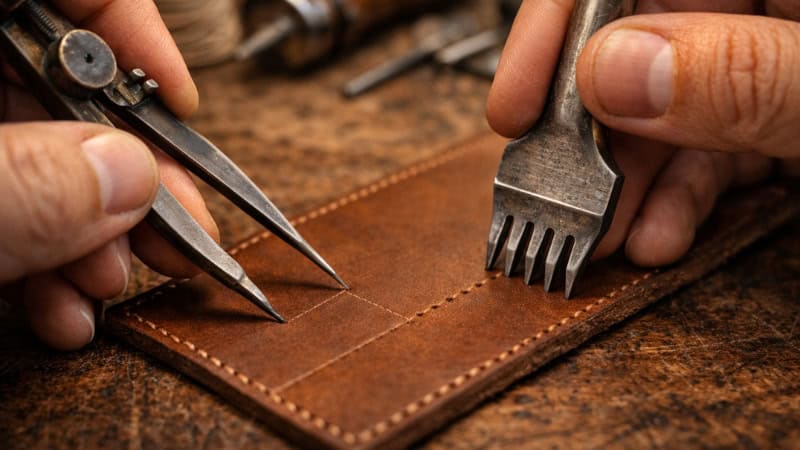
Proper preparation determines whether your stitches appear clean and evenly spaced. Before sewing begins, leather must be marked, aligned, and punched with accurate stitching holes.
Marking the Stitch Line
The stitch line serves as a guide, keeping all stitches evenly spaced from the edge of the leather. Leatherworkers typically use a wing divider or stitch groover to mark this line.
A wing divider creates a shallow guideline parallel to the leather edge, ensuring consistent spacing. A stitch groover, on the other hand, cuts a narrow groove into the leather surface so the thread sits slightly recessed and protected from abrasion.
This step helps produce clean, professional-looking seams.
Punching Stitch Holes
After marking the stitch line, stitching holes must be punched using tools such as pricking irons or diamond stitching chisels. These tools create evenly spaced holes along the seam where the needles will pass through.
Leatherworkers position the tool along the marked stitch line and strike it with a mallet to punch the holes. Maintaining straight alignment is essential to ensure consistent stitches.
Many craftsmen prefer diamond-shaped holes because they guide the thread into a natural, angled pattern.
Choosing the Right Stitch Spacing
Stitch spacing affects both the strength and visual style of the finished seam. Smaller spacing creates a refined appearance, while wider spacing is often used for thicker leather goods.
Fine leather items such as wallets or watch straps typically use a spacing of about 3 millimeters, producing tight, elegant stitches. Larger products like belts or bags often use 4 to 5 millimeter spacing, which provides additional strength for thicker leather layers.
Selecting the appropriate spacing ensures that the stitch line complements the size and function of the leather product.
Step-by-Step Saddle Stitching Leather
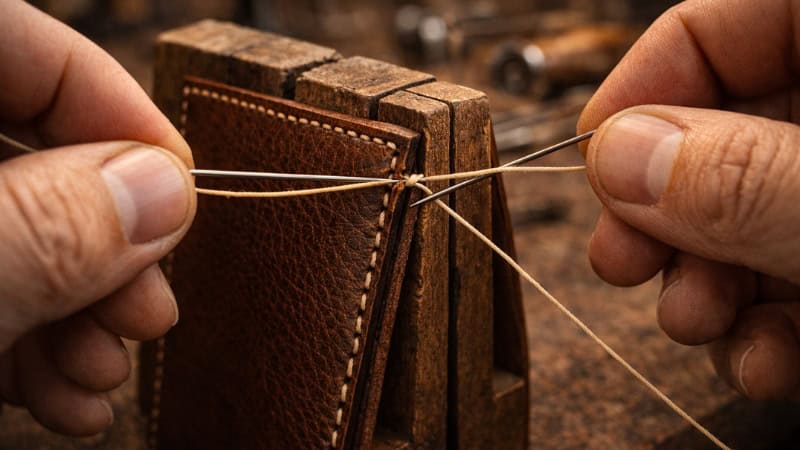
Once the leather has been prepared and the stitching holes are punched, the actual saddle stitching process begins. This method uses two needles attached to opposite ends of the same thread. By passing both needles through every hole in opposite directions, leatherworkers create a strong locking stitch that securely holds the seam. The following steps walk through the full process used by professional leatherworkers.
Cut and Prepare the Thread
The first step is measuring and cutting the thread to the proper length. A general rule used by many leatherworkers is to cut thread approximately three to four times the length of the seam being stitched. This ensures enough thread to complete the entire seam without running short.
Once the thread is cut, the ends should be slightly flattened or twisted to make threading the needles easier. If you are using linen thread, you can apply additional wax to improve durability and reduce friction while stitching.
Proper thread preparation prevents tangling and helps the thread move smoothly through the leather holes.
Thread Both Needles Properly
Saddle stitching requires two harness needles, one attached to each end of the thread. Instead of tying knots, leatherworkers typically lock the thread onto each needle.
To do this, pass the thread through the needle eye and pull a short section through. Then pierce the thread with the needle and pull it tight so the thread grips the needle firmly. This technique prevents the needle from slipping off during stitching.
A properly locked needle allows smooth and controlled stitching throughout the seam.
Secure the Leather in a Stitching Pony
Before beginning the stitches, the leather pieces should be held securely using a stitching pony or stitching clamp. This tool holds the leather vertically between two jaws, leaving both hands free for stitching.
Stabilizing the leather helps maintain consistent tension and prevents the seam from shifting while sewing. It also improves accuracy when passing needles through each hole.
Using a stitching pony is common practice among leatherworkers because it significantly improves stitching precision.
Start the First Saddle Stitch
To begin saddle stitching, insert one needle through the first hole until the thread is centered evenly between both sides of the leather. This ensures equal thread length on both needles.
Next, pass the left needle through the next hole. Before pulling it tight, insert the right needle through the same hole from the opposite side. The threads will cross inside the leather, forming the locking structure of the saddle stitch.
Once both needles pass through the hole, pull the thread evenly from both sides to tighten the stitch. Maintaining balanced tension at this stage is important for keeping the stitch line straight.
Continue the Stitching Pattern
The saddle stitch follows a consistent rhythm throughout the seam. For each new hole, one needle passes through first, followed by the second needle from the opposite direction.
As the needles cross inside the leather, they create the strong locking pattern that defines saddle stitching. The thread should be pulled firmly but not excessively tight, as too much tension can distort the leather.
Consistent hand motion helps produce evenly angled stitches. Many leatherworkers also maintain the same needle order throughout the process, which helps keep the thread pattern uniform across the seam.
With practice, the stitching rhythm becomes smooth and controlled, producing clean and professional stitch lines.
Finishing the Saddle Stitch
When the final hole is reached, the seam must be secured to prevent unraveling. Leatherworkers usually finish by backstitching, which involves sewing two or three stitches backward through the previous holes.
Backstitching locks the thread within the seam and prevents the stitch line from loosening over time. After completing the backstitches, the remaining thread can be trimmed close to the leather surface.
Some leatherworkers lightly melt the ends of synthetic thread or gently hammer the seam so the thread settles neatly into the leather.
This finishing process ensures the saddle stitch remains secure and visually clean.
Saddle Stitch vs Machine Stitch
Both saddle stitching and machine stitching are used in leathercraft, but they differ significantly in strength, construction, and application. Understanding these differences helps leatherworkers decide which method is best suited for a particular project.
Strength Comparison
Saddle stitching is widely regarded as stronger than machine stitching because each stitch is created using two independent threads. When these threads cross inside the leather, they form a tight locking pattern that holds the seam securely.
Machine stitching typically uses a lockstitch system formed by a top thread and a bobbin thread. If one section of the thread breaks, the seam can begin to unravel quickly.
Because saddle stitching does not rely on a single continuous loop, the seam maintains its integrity even if one part of the thread becomes damaged.
Durability and Longevity
Hand-stitched leather seams tend to last longer under heavy use. Each stitch is individually tightened by the leatherworker, allowing consistent tension across the seam.
Machine stitching is faster and more efficient for large-scale production, but it can sometimes create weaker seams if the thread breaks or loosens.
For high-quality leather goods that last for many years, saddle stitching is often the preferred method.
When to Choose Each Method
Saddle stitching is commonly chosen for handcrafted leather goods where durability, precision, and visual quality are important. Products such as wallets, belts, and knife sheaths often benefit from the strength of hand stitching.
Machine stitching is better suited for mass production or for projects that require long seams to be completed quickly. Many manufacturers use machine stitching for efficiency while reserving saddle stitching for premium handmade items.
Common Saddle Stitching Mistakes
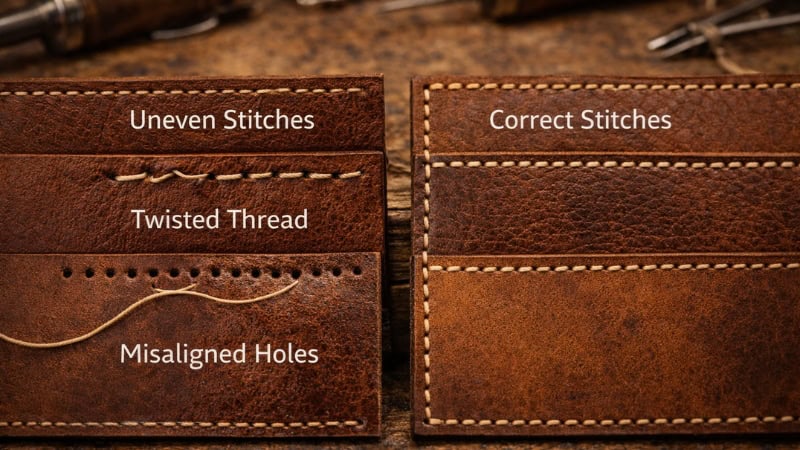
Even though saddle stitching is a simple technique in theory, beginners often make small mistakes that affect the seam’s appearance and durability. Avoiding these common issues can significantly improve the quality of your leather stitching.
- Uneven stitch tension
Pulling the thread too tightly on one side can distort the stitch pattern or cause the leather to wrinkle. Maintaining consistent tension on both sides of the thread helps keep stitches balanced. - Misaligned stitching holes
If pricking irons or stitching chisels are not aligned properly, the stitch line can appear uneven. Carefully positioning the tools along the stitch line ensures consistent spacing. - Twisted thread during stitching
The thread can twist as it passes repeatedly through the leather holes. Allowing the thread to untwist periodically helps maintain smooth and uniform stitches. - Skipping backstitching at the end
Failing to secure the seam with backstitches can cause the thread to loosen over time. Always finish the seam with at least two or three backstitches. - Using the wrong thread thickness
Thread that is too thick or too thin for the hole size can affect both appearance and durability. Matching the thread size to the stitch spacing produces cleaner results.
Pro Tips for Perfect Saddle Stitches
Mastering saddle stitching requires more than just following the basic technique. Small adjustments in tension, tool use, and stitching rhythm can significantly improve the seam’s final appearance and durability. The following professional tips help leatherworkers achieve clean, consistent, and long-lasting saddle stitches.
- Maintain consistent thread tension
Pull the thread evenly from both sides after every stitch. Balanced tension keeps the stitch line straight and prevents one side of the seam from appearing tighter than the other. - Keep the same needle order while stitching
Many experienced leatherworkers always pass the same needle through every hole first. This habit keeps the stitch pattern consistent and prevents uneven thread angles. - Use high-quality waxed thread
Waxed polyester thread or waxed linen thread moves more smoothly through the leather holes and reduces friction during stitching. It also improves durability and resistance to wear. - Keep stitching holes clean and aligned
When punching holes with pricking irons or stitching chisels, ensure the tool is aligned with the stitch line. Clean holes help the needles pass through smoothly and maintain an even stitch pattern. - Let the thread untwist periodically
Repeated stitching can twist the thread, especially when using longer seams. Allowing the thread to hang freely for a moment helps it untwist naturally and prevents irregular stitches. - Practice on scrap leather first
Before stitching a finished project, practice the technique on leftover leather pieces. This helps you develop a steady stitching rhythm and refine your tension control.
FAQs About Saddle Stitching Leather
What is saddle stitching in leather?
Saddle stitching is a traditional hand-sewing technique used in leathercraft, in which two needles are attached to opposite ends of a single thread. Each needle passes through the same hole in opposite directions, creating a strong locking stitch that securely holds leather pieces together.
Why is saddle stitching stronger than machine stitching?
Saddle stitching is stronger because each stitch is formed by two independent threads crossing inside the leather. If one thread breaks, the rest of the seam remains intact. Machine stitching uses a continuous loop system that can unravel more easily if the thread fails.
What thread is best for saddle stitching leather?
The best thread for saddle stitching is usually waxed polyester or waxed linen. Waxed polyester is highly durable and moisture resistant, while linen thread provides a traditional appearance favored by many leatherworkers.
How long should the thread be for saddle stitching?
A common rule is to cut thread three to four times the length of the seam being stitched. This provides enough thread to complete the seam comfortably without running out before finishing the stitches.
Do you need special needles for saddle stitching?
Yes. Saddle stitching requires harness needles with blunt tips. These needles pass through pre-punched holes in the leather without cutting the fibers or damaging the thread.
Building Durable Leather Projects with Saddle Stitching
Saddle stitching is one of the most reliable and time-tested techniques in leathercraft. Using two needles and a single thread, this method creates strong, durable seams that can withstand years of use. Although it requires patience and practice, mastering saddle stitching allows leatherworkers to produce clean, professional stitch lines that enhance both the strength and appearance of handmade leather goods.
With the right tools, proper preparation, and consistent technique, even beginners can learn to create durable leather seams. As you practice and refine your skills, saddle stitching becomes an essential skill for crafting high-quality leather products.
