
Humidity directly impacts leather because leather is a porous, natural material that absorbs moisture from the air. High humidity causes mold, mildew, odors, and warping, while low humidity leads to dryness, cracking, and peeling.
The safe humidity range for leather is 40%–55% relative humidity. Staying within this range preserves leather’s flexibility, strength, and appearance.
This guide explains how humidity damages leather, how to spot early warning signs, and practical steps to protect, restore, and store leather properly—based on real-world leather care best practices.
What Is Humidity and Why Is Leather Sensitive to It
Humidity is the amount of moisture in the air, commonly measured as relative humidity (RH). Leather is especially sensitive to humidity because it is a natural, porous material that constantly absorbs and releases moisture from its environment.
When humidity fluctuates, leather fibers expand or contract. Over time, this disrupts the internal collagen structure, leading to visible and structural damage.
Why does leather react to humidity?
- Porous structure: Leather contains microscopic pores that absorb airborne moisture.
- Hygroscopic behavior: Leather naturally pulls moisture from humid air and releases it in dry air.
- Organic composition: Made from animal hide, leather behaves differently from synthetic materials.
These properties make humidity control essential for long-term leather care.
How High Humidity Affects Leather
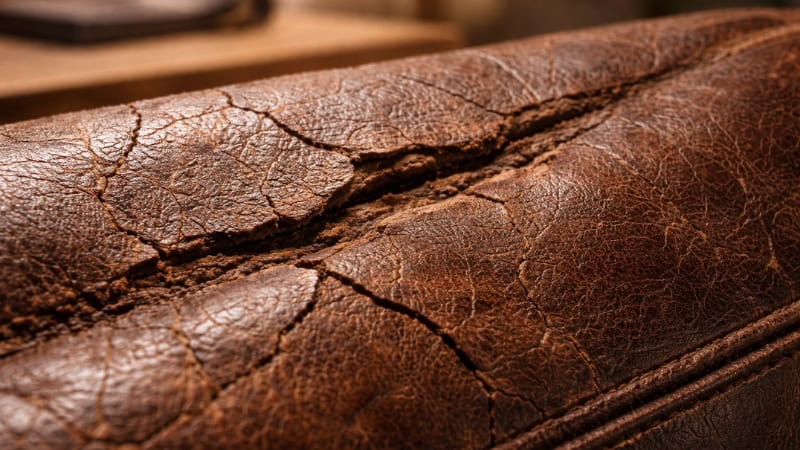
High humidity—typically above 60% RH—poses the greatest risks to leather. Excess moisture weakens fibers and creates ideal conditions for biological growth.
Primary effects of high humidity on leather
- Mold and mildew growth: Moist environments allow fungi to grow on and inside leather.
- Warping and bubbling: Absorbed moisture causes fibers to swell unevenly.
- Sticky or tacky surface: Oils migrate to the surface when moisture levels spike.
- Musty odors: Trapped moisture feeds bacteria, resulting in persistent smells.
Leather furniture, shoes, and bags stored in basements, closets, or coastal homes are especially vulnerable.
How Low Humidity Damages Leather
Low humidity—typically below 35–40% RH—removes essential moisture from leather. While less visible at first, the damage on leather compounds over time.
Common problems caused by dry air
- Dryness and cracking: Leather loses natural oils and becomes brittle.
- Stiffness and loss of flexibility: Fibers tighten and harden.
- Peeling and flaking: Protective coatings separate from the hide.
- Color fading: Pigments degrade faster in dry environments.
This is common in heated homes, air-conditioned spaces, and dry climates.
Ideal Humidity Level for Leather Storage and Use
Leather performs best when the surrounding environment remains stable. Because leather slowly absorbs and releases moisture, even small humidity fluctuations can compound into long-term damage.
Best Humidity Range for Leather
The ideal humidity level for leather is 40% to 55% relative humidity (RH). This range allows leather fibers to retain elasticity without absorbing excess moisture or losing essential oils.
When humidity stays within this window, leather maintains its shape, surface integrity, and natural flexibility across furniture, footwear, apparel, and accessories.
Why Stability Matters More Than Short-Term Fluctuations
Leather reacts poorly to repeated humidity swings. Expansion in humid air and contraction in dry air gradually weaken the collagen fiber structure.
Stable humidity prevents internal stress, reduces surface cracking, and slows fiber fatigue—making consistency more important than brief corrective actions.
How to Measure Humidity Where Leather Is Stored
Humidity should be monitored where leather actually lives, not just in open rooms. Closets, cabinets, and storage units often trap moisture unnoticed.
Digital hygrometers and smart humidity monitors provide accurate readings and early warnings before visible damage occurs, enabling preventive action rather than restoration.
Types of Leather Most Affected by Humidity
Leather reacts to humidity based on how exposed its fibers are and how much surface treatment it has received. Understanding these differences helps prioritize care.
Full-Grain Leather and Moisture Absorption
Full-grain leather retains the natural outer hide, making it breathable but highly absorbent. This allows it to age beautifully in controlled conditions but leaves it vulnerable in humid environments.
Without airflow and humidity control, full-grain leather absorbs moisture deeply, increasing the risk of mold and internal weakening despite its overall durability.
Top-Grain and Genuine Leather Sensitivity
Top-grain leather has a corrected surface that slightly slows moisture absorption. Genuine leather, often thinner and layered, reacts faster to both humidity and dryness.
In humid air, these leathers can trap moisture beneath surface coatings. In dry conditions, they lose oils quickly, leading to stiffness and cracking.
Suede and Nubuck as High-Risk Materials
Suede and nubuck expose inner fibers directly to the environment. This makes them extremely sensitive to humidity changes and staining.
Even brief exposure to humid air can cause discoloration, odor retention, and irreversible texture changes, making strict environmental control essential.
Coated and PU-Finished Leather Behavior
Coated and PU-finished leathers rely on bonded surface layers for durability. These layers are especially vulnerable to humidity imbalance.
High humidity weakens adhesion, while low humidity causes brittleness and peeling. Damage often begins at flex points where material stress is highest.
Signs Your Leather Has Been Damaged by Humidity
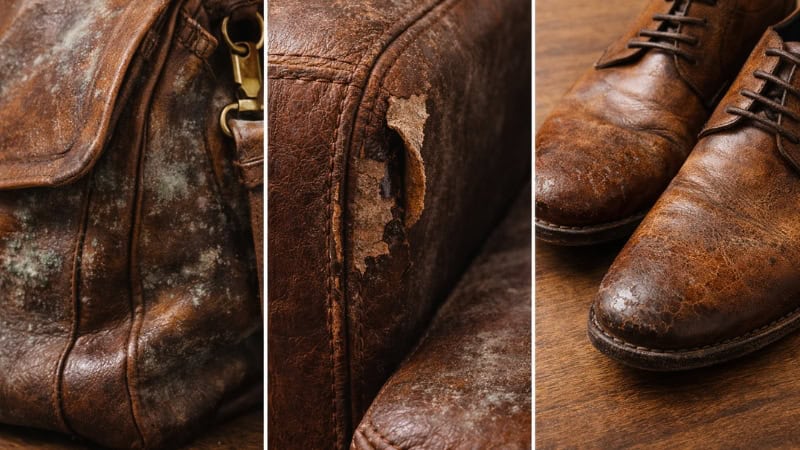
Early detection prevents permanent damage. Most humidity-related issues show visible, tactile, or odor-based signs.
Visual indicators
- Mold spots or discoloration
- Bubbling or warping
- Flaking or peeling
Texture changes
- Sticky or tacky feel
- Stiffness or hardness
- Surface cracking
Smell indicators
- Damp or musty odor that persists after airing
These signs often worsen quickly if humidity remains uncontrolled.
What to Do If Leather Is Exposed to High Humidity
When leather is exposed to high humidity, speed and restraint matter more than aggressive treatment. Acting quickly can stop mold growth, prevent fiber distortion, and preserve the leather’s natural oils. The goal is to stabilize moisture, not force-dry the material.
Immediate steps to stop moisture damage
- Move the leather to a dry, well-ventilated area.
- Choose a space with controlled airflow and moderate temperature. Avoid enclosed rooms where moisture lingers.
- Gently remove surface moisture.
- Use a clean, dry microfiber cloth to blot—never rub—the leather surface.
- Allow slow, natural drying.
- Let leather air-dry at room temperature. Forced heat accelerates cracking and warping.
How to remove mold and mildew from leather safely
- Prepare a mild cleaning solution.
- Mix equal parts of isopropyl alcohol and water. This kills mold spores without oversaturating the hide.
- Spot-clean affected areas
- Lightly dampen a cloth and wipe gently. Avoid soaking seams or stitching.
- Dry completely before storage.
- Air-dry leather fully before reintroducing it to controlled storage.
Reconditioning after humidity exposure
- Apply a leather conditioner once the leather feels dry but not stiff.
- Focus on restoring lost oils, not adding shine.
- Allow 24 hours for absorption before use or storage.
If mold odor persists or structural damage appears, professional leather care is recommended.
How to Protect Leather from Humidity Long-Term
Long-term leather protection depends on environmental control, proper storage, and routine care. Preventive measures are more effective—and less costly—than restoration.
Best practices for leather storage
- Store leather in breathable fabric dust bags, not plastic.
- Keep leather off floors and away from exterior walls.
- Allow air circulation around stored items.
Using humidity control tools
- Dehumidifiers: Ideal for humid climates, basements, and storage rooms.
- Silica gel or moisture absorbers: Useful for closets, drawers, and travel storage.
- Hygrometers: Monitor RH levels and catch problems early.
Leather care routine for humid environments
- Clean leather regularly to remove moisture-attracting dirt.
- Condition every 3–6 months, depending on exposure.
- Inspect high-risk items (shoes, bags) monthly.
This layered approach minimizes both moisture buildup and overdrying.
Climate-Specific Leather Care – Tropical vs Dry Regions
Leather reacts differently depending on the climate. Adapting care routines to regional conditions prevents slow, unnoticed damage.
Leather care in humid and tropical climates
High humidity accelerates mold growth and odor retention.
Best practices
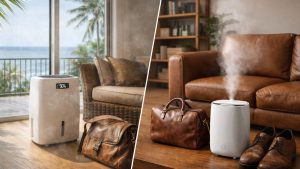
- Use dehumidifiers year-round, not seasonally.
- Ventilate storage areas daily when possible.
- Avoid stacking leather items tightly together.
- Rotate frequently used leather to allow it to air.
Coastal and monsoon regions require proactive humidity management.
Leather care in dry or air-conditioned environments
Low humidity strips leather of essential moisture.
Best practices
- Use humidifiers to stabilize indoor air.
- Condition leather more frequently to replenish oils.
- Keep leather away from heaters and AC vents.
- Avoid prolonged sun exposure through windows.
Balanced humidity—not constant conditioning—is the key.
Common Mistakes People Make When Storing Leather
Many humidity problems stem from improper storage rather than climate alone.
Mistakes to avoid
- Storing leather in plastic bags
- Keeping leather in basements or attics
- Over-conditioning to “fix” dryness
- Ignoring humidity levels entirely
Correct storage is as important as cleaning or conditioning.
Expert Tips to Extend the Life of Leather
Experienced leather professionals follow consistent, preventive routines.
Expert-backed practices
- Maintain stable humidity year-round
- Clean before conditioning
- Spot-test products before full application
- Address humidity issues before visible damage appears
These habits protect both appearance and structure.
Final Takeaway: Humidity Control Is Essential for Leather Longevity
Leather longevity depends on moisture balance, not just cleaning or conditioning. Both high and low humidity can cause irreversible damage if ignored.
Maintaining 40%–55% relative humidity, using proper storage methods, and responding quickly to environmental changes keep leather strong, flexible, and visually appealing for years.
For deeper guidance on storage, conditioning, and restoration, this article naturally connects with our leather care pillar guide, where each step is explained in greater detail without overcomplication.
