
Leather is everywhere—from jackets and handbags to furniture and car interiors—but not all leather is created equal. Knowing how to test leather helps you understand what you’re really paying for and whether a product will last over time. A quick inspection can save you from poor-quality or synthetic substitutes.
Testing leather doesn’t require expensive tools or expert training. Many reliable methods rely on your senses and a bit of careful observation. When done correctly, these tests are simple, safe, and surprisingly effective.
In this guide, we’ll walk through practical ways to test leather step by step. Each method builds on the previous one, helping you gain confidence as you move from basic checks to more detailed evaluations.
Understanding Leather Basics
Leather is a natural material made from animal hides that have been tanned to prevent decay. Its quality depends on the hide source, tanning process, and how much the surface has been altered. Before testing leather, it’s important to know what you’re dealing with so your observations make sense.
- Types of real leather: Full-grain leather retains the natural surface and is the most durable, while top-grain leather is sanded for a smoother look. Genuine leather is a broad, often lower-quality category, and bonded leather contains scraps fused with adhesives.
- Natural vs. synthetic: Real leather is porous, flexible, and ages over time. Synthetic leather is plastic-based, uniform, and doesn’t develop a natural patina.
- Why structure matters: Leather fibers are interwoven, not layered like fabric or plastic. This affects how it bends, absorbs moisture, and reacts to wear.
Once you understand how leather is made and classified, it becomes much easier to interpret the results of simple at-home tests, which we’ll explore next.
Visual Inspection Tests
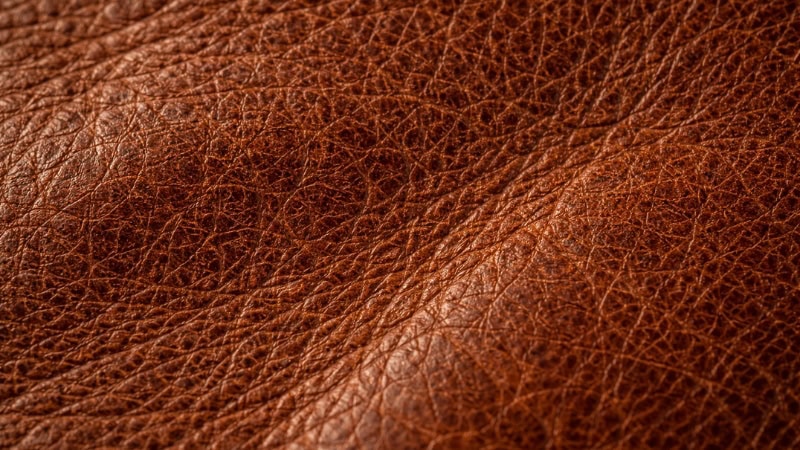
The first and safest way to test leather is by simply looking at it closely. Real leather rarely looks perfect, and those small imperfections are often a good sign of authenticity.
- Grain pattern: Genuine leather has an irregular grain with natural variation. If the pattern looks overly uniform or repeated, it may be synthetic or embossed.
- Surface imperfections: Scars, pores, and wrinkles indicate natural hide. Perfectly smooth surfaces often suggest heavy processing or imitation materials.
- Color depth: Real leather has subtle tonal variations rather than flat, uniform coloring.
- Finish quality: Excessive shine or thick coatings can mask low-quality leather or bonded materials.
Visual inspection won’t give you a final answer on its own, but it provides strong clues without risking damage. After seeing how leather looks, the next step is to understand how it feels in your hands.
Touch and Flexibility Tests
Touch reveals a lot about leather quality because natural hide behaves differently than plastic-based materials. A simple hands-on test can quickly confirm or challenge what you saw visually.
- Temperature response: Real leather feels warm and adjusts to your body temperature quickly. Synthetic leather often stays cool to the touch.
- Softness and texture: Quality leather feels supple, not stiff or rubbery. It should have a slightly uneven texture rather than a plastic-smooth finish.
- Flex and bend test: Gently bend the leather. Real leather forms soft wrinkles and returns to shape, while faux leather may crease sharply or resist movement.
- Pressure reaction: Press your thumb into the surface—natural leather shows subtle color or texture changes as fibers shift.
Touch testing helps confirm authenticity while also hinting at durability and comfort. Once you’ve felt the leather, your nose can offer another surprisingly reliable clue.
Smell Test
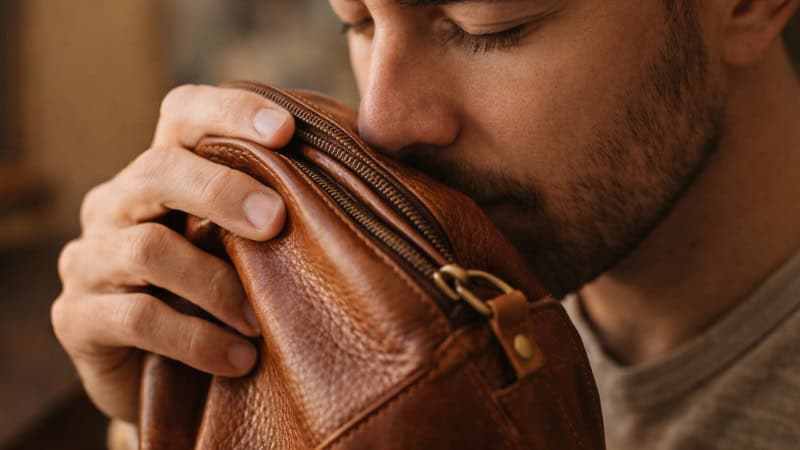
The smell test is one of the oldest ways to identify real leather, and it’s still useful today. Leather has a distinct, organic scent that’s difficult to replicate.
- Natural leather aroma: Genuine leather smells earthy, rich, and slightly musky due to the tanning process.
- Synthetic odors: Faux leather often smells like plastic, chemicals, or glue. These smells can become stronger when the material warms up.
- Limitations: Some treated leathers may have mild chemical notes, and new products can mask natural smells with finishes.
While not foolproof on its own, smell works best when combined with touch and visual tests. If you want to go one step further, water absorption can reveal how porous the material really is.
Water Absorption Test
Leather is naturally porous, which means it absorbs small amounts of moisture. This makes the water test a useful—but careful—method.
- How to test: Place a single drop of water on an inconspicuous area. Do not rub or soak the leather.
- Real leather reaction: The water slowly absorbs and darkens the spot before drying.
- Synthetic reaction: Water beads up and remains on the surface without absorption.
- Precautions: Avoid testing finished or delicate leather, as water may stain untreated areas.
This test provides clear results with minimal risk when done properly. If you need further confirmation, more assertive tests exist—but they should be used sparingly.
Heat and Flame Test (With Warnings)
This test is controversial and should only be used on scrap leather or hidden edges. It helps distinguish natural hide from plastic-based materials.
- Real leather response: When exposed to flame, leather chars slowly and smells like burnt hair.
- Synthetic response: Faux leather melts, shrinks, or produces a sharp plastic odor.
- Safety first: Use tweezers, work in a ventilated area, and avoid finished products.
- When to avoid: Never use this test on valuable items or completed goods.
Because it’s destructive, this test is rarely necessary if earlier methods align. A less invasive alternative is checking how the surface reacts to light scratches.
Scratch Test
Leather’s fibrous structure allows it to respond uniquely to minor surface scratches. This makes the scratch test helpful when done gently.
- How to perform: Use a fingernail to lightly scratch a hidden area.
- Real leather behavior: Minor scratches often fade as natural oils redistribute.
- Synthetic behavior: Marks remain permanent or reveal a different-colored layer beneath.
- Coated leather note: Heavy finishes may limit visible reaction, even on real leather.
This test also hints at how leather will age over time. Next, inspecting the edges and backing can provide structural confirmation.
Edge and Backing Inspection
The edges of leather reveal how the material is constructed. This is especially useful for belts, straps, or cut samples.
- Raw edges: Real leather has rough, fibrous edges rather than smooth plastic-like ones.
- Layering: Bonded leather may show layered construction or fabric backing.
- Backing material: Synthetic leather often has cloth or mesh backing visible on the underside.
- Edge sealing: Painted edges can hide structure, so inspect discreet areas if possible.
Once you’ve examined structure and surface, professional and chemical tests offer deeper validation when needed.
Chemical and Professional Tests
When accuracy matters—such as in manufacturing or restoration—professional testing may be required.
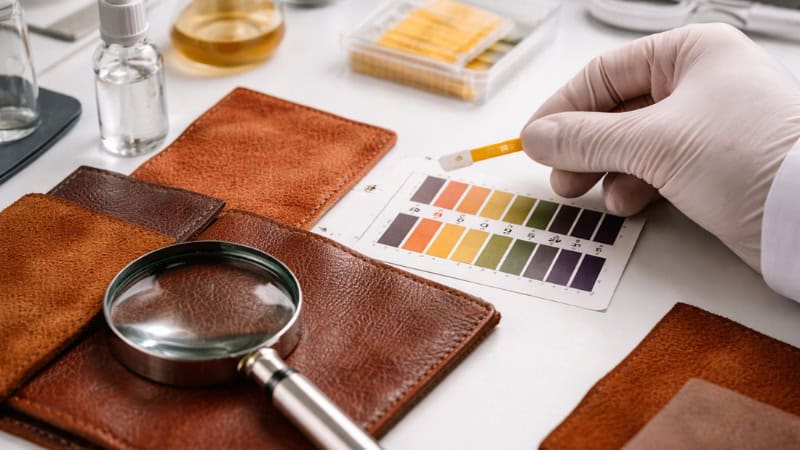
- pH testing: Helps determine tanning quality and long-term durability.
- Microscopic analysis: Reveals fiber structure unique to real leather.
- Lab verification: Confirms authenticity beyond surface treatments.
- When to use: For bulk purchases, disputes, or high-value items.
Most consumers won’t need these methods, especially if common myths don’t mislead them—something we’ll clear up next.
Common Myths About Testing Leather
Many misconceptions cause confusion when testing leather, leading to poor conclusions.
- “Genuine leather means high quality”: It’s a marketing term, not a quality guarantee.
- “One test is enough”: Reliable results come from combining multiple methods.
- “All leather smells the same”: Tanning methods affect scent significantly.
- “Synthetic leather can’t look real”: Modern faux materials can be visually convincing.
Understanding these myths helps you test smarter. To wrap things up, a few best practices can make your testing process safer and more reliable.
Best Practices and Tips
Testing leather works best when done carefully and thoughtfully. Small details make a big difference.
- Combine methods: Use visual, touch, and smell tests together.
- Test hidden areas: Avoid visible damage to finished products.
- Be patient: Let leather respond naturally before judging results.
- Care afterward: Condition leather if water or pressure was applied.
With these tips in mind, you’re ready to make informed decisions. Let’s answer a few common questions before closing.
FAQs
1. Can you test leather without damaging it?
Yes, most tests like visual inspection, touch, and smell are completely non-destructive. When done gently, they provide reliable insights without harming the leather.
2. Is water testing safe for all leather types?
Water testing is safe for many leathers but not all. Finished or delicate leathers may stain, so it’s best to test hidden areas and use minimal moisture.
3. Does real leather always smell strong?
Not always. Some real leathers have mild scents due to finishes or aging, while synthetic leather usually has a sharper chemical smell.
4. Can synthetic leather pass most tests?
High-quality faux leather can mimic appearance and feel. However, it usually fails absorption, edge, or heat-related tests.
5. Is the flame test necessary?
No, it’s rarely necessary for consumers. It’s best reserved for scrap samples or industrial settings due to its destructive nature.
6. How can I tell leather quality, not just authenticity?
Quality shows in thickness, flexibility, grain integrity, and how the leather ages over time. Authenticity alone doesn’t guarantee durability.
Final Thoughts: Test Smart, Buy Better
Knowing how to test leather puts you in control as a buyer or maker. With a few simple checks, you can spot authenticity, avoid low-quality substitutes, and understand what gives leather its value.
Leather testing doesn’t need to be complicated or risky. Start with your senses, move carefully, and trust patterns rather than single results.
When you test smart, you buy better—and your leather goods reward you with comfort, durability, and character that only real leather can offer.
