
Ethically tanned leather items are made using environmentally responsible tanning processes, safer chemical management, and transparent sourcing practices. Unlike conventional chrome-tanned leather, ethical leather prioritizes vegetable tanning, chrome-free methods, wastewater treatment, and certified supply chains.
In 2026, buying leather is no longer just about durability or aesthetics. Conscious consumers want sustainable leather goods, low-toxicity processing, and verified certifications such as Leather Working Group (LWG) or OEKO-TEX®.
This guide shows you exactly how to identify, verify, and confidently purchase ethically tanned leather products—without greenwashing, confusion, or marketing jargon.
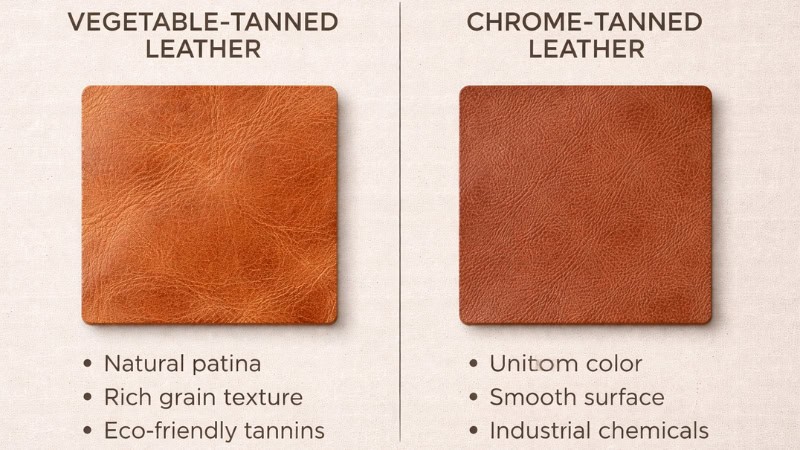
What Is Ethically Tanned Leather?
Ethically tanned leather refers to leather processed using eco-friendly tanning methods, regulated chemical use, and responsible labor practices. It focuses on reducing environmental harm while maintaining durability and performance.
At its core, ethical tanning addresses three areas:
- Chemical Safety – Reduced or eliminated chromium salts; safer alternatives like vegetable tannins or chrome-free agents.
- Environmental Impact – Wastewater treatment, lower carbon footprint, compliance with REACH regulations.
- Human & Animal Ethics – Responsible sourcing (often as a by-product of the meat industry) and fair labor conditions.
Ethical Leather vs Conventional Leather
| Factor | Ethically Tanned Leather | Conventional Chrome-Tanned Leather |
| Chemicals | Vegetable tannins / chrome-free | Chromium salts |
| Environmental Risk | Lower toxicity, managed effluents | Heavy metal contamination risk |
| Transparency | Certification-backed | Often unclear |
| Longevity | Develops natural patina | Uniform appearance |
Ethically Tanned Leather is leather processed using environmentally safer tanning methods, certified chemical management systems, and transparent supply chains to reduce pollution and protect workers.
Types of Ethical Leather Tanning Methods
Understanding tanning processes helps you avoid greenwashing and choose truly sustainable leather products.
1. Vegetable-Tanned Leather
Vegetable tanning uses natural tannins extracted from tree bark, mimosa, chestnut, or quebracho. It is one of the oldest and most environmentally responsible tanning techniques.
Why it matters:
- Biodegradable processing inputs
- Develops a rich patina over time
- Lower heavy-metal discharge
- Ideal for wallets, belts, structured bags
Vegetable-tanned leather has a subtle earthy smell and gradually darkens with exposure—clear indicators of authentic plant-based tanning.
2. Chrome-Free Leather
Chrome-free leather avoids chromium salts entirely. Instead, it uses aldehyde or other metal-free tanning systems.
Best for:
- Sensitive skin products
- Baby footwear
- Interior goods
Look for labels stating “metal-free leather” or “chrome-free certified.”
3. Responsible Chrome Tanning (When Managed Correctly)
Not all chrome tanning is automatically unethical. Some modern tanneries operate closed-loop systems with wastewater treatment facilities, reducing environmental discharge.
Verify:
- Leather Working Group (LWG) certification
- REACH compliance
- ISO 14001 environmental management
The key difference is chemical recovery and safe disposal systems, not just the tanning agent used.
Sustainable Leather Alternatives
Sustainable leather alternatives aim to reduce environmental impact, lower reliance on heavy chemical tanning, and minimize waste. While not all alternatives outperform responsibly tanned leather, some offer meaningful environmental advantages when evaluated through lifecycle assessment (LCA), durability, and end-of-life disposal.
Recycled Leather (Bonded or Reconstituted Leather)
Recycled leather is made from leather scraps and offcuts that would otherwise enter landfill. These fibers are shredded and bonded together using natural or synthetic binders to create new sheets of material.
This approach reduces production waste and maximizes resource efficiency. However, durability depends heavily on the binding agents used. High-quality recycled leather with low synthetic content can extend material life, but cheaper versions may crack over time.
When buying recycled leather products, check for transparency about binder composition and overall material percentage.
Upcycled Leather
Upcycled leather involves repurposing surplus hides, deadstock materials, or factory offcuts into new products. Unlike recycling, the original leather structure remains intact.
This method avoids additional tanning processes and reduces raw material demand. It is particularly common among artisanal brands and small-batch sustainable leather workshops.
Upcycling aligns strongly with circular economy principles because it extends the useful life of existing materials without additional chemical processing.
Bio-Based Leather Alternatives (Plant & Lab-Grown Materials)
Innovations like Piñatex (pineapple fiber), Mylo (mycelium-based material), and cactus leather aim to provide lower-impact alternatives to traditional leather.
These materials often reduce livestock dependency and heavy tanning chemicals. However, some still rely on polyurethane coatings for durability, which affects biodegradability.
For consumers focused on reducing animal-derived materials, bio-based options can be a viable choice. For those prioritizing longevity and repairability, high-quality vegetable-tanned leather may still outperform many plant-based alternatives in long-term sustainability.

How to Identify Ethically Tanned Leather – Step-by-Step Buying Guide
Identifying ethically tanned leather requires verifying tanning methods, certifications, and brand transparency. Marketing claims alone are not sufficient. The following sections explain how to assess a product thoroughly before purchasing.
Step 1: Start With Certification Verification
Certifications serve as third-party validation of environmental and chemical management practices. Look for references to Leather Working Group (LWG), OEKO-TEX® Leather Standard, or REACH compliance.
A credible brand will specify whether the tannery—not just the finished product—is certified. The absence of tannery-level disclosure often signals incomplete transparency.
Certification is not a guarantee of perfection, but it significantly reduces the risk of unethical tanning practices.
Step 2: Understand the Tanning Method Used
Ethical leather brands clearly state whether the leather is vegetable-tanned, chrome-free, or responsibly chrome-tanned within closed-loop systems.
Vegetable-tanned leather uses plant-derived tannins and typically develops a natural patina. Chrome-free leather avoids chromium salts entirely. Responsible chrome tanning, when properly managed with wastewater treatment and chemical recovery systems, can also meet environmental standards.
If a product description only says “genuine leather,” that is insufficient detail.
Step 3: Evaluate Supply Chain Transparency
Ethically sourced leather involves traceability from raw hide sourcing to tannery processing and manufacturing.
Brands aligned with sustainable fashion principles disclose sourcing regions, tannery partnerships, and environmental management practices. Many publish sustainability reports or supplier standards.
Transparency builds trust and aligns with E-E-A-T expectations in modern consumer markets.
Step 4: Examine Physical Characteristics Carefully
Although not definitive proof, certain physical cues can support verification.
Vegetable-tanned leather typically has a subtle natural scent rather than a chemical odor. It may display tonal variations and gradually darken with use.
Chrome-heavy leather often has a uniform finish and chemical smell. However, physical inspection should complement certification checks—not replace them.
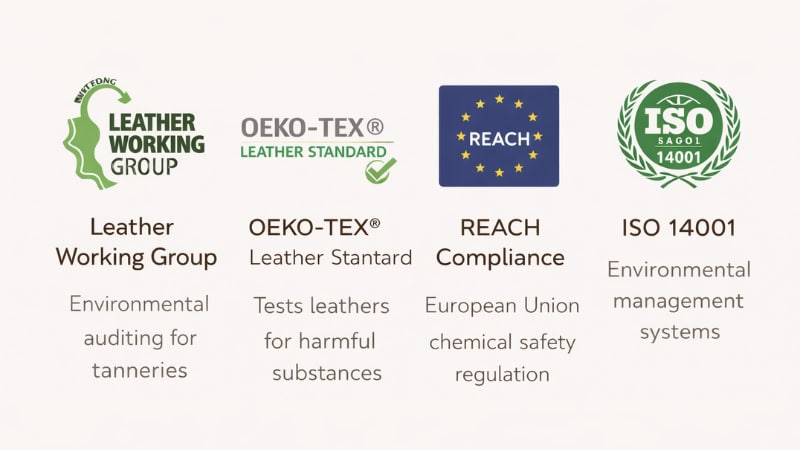
Best Certifications to Look For in Sustainable Leather Products
Certifications reinforce credibility and reduce reliance on brand marketing language. Below are the most recognized standards within the ethical leather industry.
Leather Working Group (LWG)
The Leather Working Group audits tanneries worldwide for environmental compliance. It evaluates water usage, energy consumption, waste management, chemical handling, and traceability systems.
Gold and Silver ratings indicate strong performance benchmarks. When a brand sources from LWG-certified tanneries, it demonstrates a commitment to environmental accountability within the leather supply chain.
OEKO-TEX® Leather Standard
OEKO-TEX® tests finished leather products for harmful substances that may affect human health. This certification focuses on chemical safety and skin contact risk.
It is particularly relevant for footwear, bags, and apparel that remain in direct contact with skin for extended periods.
REACH Compliance
REACH is a European Union regulation governing chemical use and safety. Leather products compliant with REACH standards must meet strict limits on hazardous substances.
While not a voluntary certification, REACH compliance indicates adherence to one of the most rigorous chemical management systems globally.
ISO 14001 Environmental Management
ISO 14001 certifies that a company maintains an environmental management system aimed at reducing impact and improving sustainability performance.
For leather production, this often means systematic wastewater treatment, waste reduction strategies, and measurable environmental goals.
B Corp Certification
B Corp status applies to the company as a whole rather than the leather itself. It assesses environmental impact, labor ethics, governance, and transparency.
Although not leather-specific, B Corp certification strengthens overall corporate responsibility signals.
Ethical Leather vs Vegan Leather: Which Is More Sustainable?
The comparison between ethical leather and vegan leather depends on production methods, materials used, and product lifespan. Sustainability should be evaluated through lifecycle analysis rather than labels alone.
Environmental Impact Comparison
Vegetable-tanned leather relies on natural tannins and can biodegrade under certain conditions. Its environmental footprint depends on water management and sourcing practices.
Many conventional vegan leathers, such as polyurethane (PU) or polyvinyl chloride (PVC), are petroleum-based and may shed microplastics over time. These materials are not biodegradable and rely heavily on fossil fuels.
Bio-based alternatives, such as mycelium leather, reduce reliance on animal agriculture. However, some still incorporate synthetic coatings for durability, affecting overall environmental performance.
The sustainability outcome varies by material composition and manufacturing standards.
Longevity & Cost-Per-Wear
Durability plays a critical role in sustainability. Full-grain vegetable-tanned leather can last decades when maintained properly. It is repairable, conditionable, and structurally strong.
Many synthetic vegan leathers have shorter lifespans and may crack or peel after several years. This short product cycle increases replacement frequency and waste generation.
From a cost-per-wear perspective, long-lasting leather items often outperform lower-cost synthetic alternatives over time.
Ethical Considerations
Ethical leather typically uses hides as a by-product of the meat industry. This approach utilizes materials that would otherwise go to waste.
Animal welfare standards vary by region and supplier. Responsible sourcing requires traceability and compliance with agricultural regulations.
Vegan leather eliminates animal-derived inputs but may rely on fossil-fuel-based plastics. Consumers must decide whether their priority lies in animal ethics, environmental impact, or material longevity.
There is no universally superior option. Transparency and lifecycle impact are more important than marketing terminology.
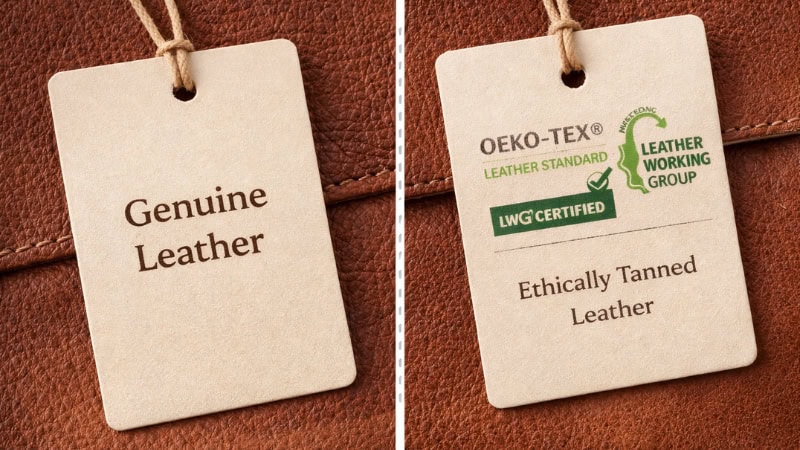
Red Flags to Avoid When Buying Leather Goods
Not all leather marketed as “eco-friendly” or “sustainable” meets ethical tanning standards. Recognizing red flags helps you avoid greenwashing and poor-quality products.
Vague Material Claims Without Tanning Details
If a product description only states “genuine leather” or “premium leather” without mentioning the tanning method, it lacks transparency. Ethical brands clearly specify whether the leather is vegetable-tanned, chrome-free, or sourced from an LWG-certified tannery.
A lack of tanning disclosure usually signals either conventional chrome tanning or incomplete traceability.
No Mention of Certifications or Compliance
Responsible leather brands reference recognized standards such as Leather Working Group (LWG), OEKO-TEX®, or REACH compliance.
If no certification, environmental commitment, or chemical management information is available, the sustainability claim may be unverified.
Credible brands provide evidence—not just marketing language.
Strong Chemical Odor
Leather that emits a harsh chemical smell may indicate heavy chemical treatment or inadequate finishing controls.
Vegetable-tanned leather typically has a mild, natural scent. While smell alone is not definitive proof, strong chemical odor can be a warning sign of poor processing standards.
Unrealistically Low Pricing
Ethically tanned leather involves regulated wastewater treatment, certified chemical management, and audited supply chains. These systems increase production costs.
If a product is significantly cheaper than comparable items claiming ethical tanning, it may not meet the same environmental or labor standards.
Price alone does not guarantee sustainability, but extremely low pricing often signals compromises in process control.
No Supply Chain Transparency
Brands aligned with sustainable leather production typically disclose tannery partnerships, sourcing regions, or sustainability commitments.
If a company avoids answering direct questions about sourcing or environmental practices, that lack of transparency is a critical red flag.
Trust in ethical leather is built on traceability.
Questions to Ask Before Buying Ethically Tanned Leather
Informed consumers strengthen sustainable markets. Asking precise questions helps verify ethical tanning claims and encourages brand accountability.
What Tanning Method Was Used?
Ask whether the leather is vegetable-tanned, chrome-free, or responsibly chrome-tanned within a closed-loop system.
A clear answer demonstrates product knowledge and production transparency. Vague responses often indicate limited traceability.
Is the Tannery Certified by Leather Working Group (LWG)?
LWG certification evaluates environmental performance at the tannery level. Knowing the tannery’s rating provides insight into water use, energy management, and chemical control.
If the brand cannot identify the tannery or its certification status, supply chain transparency may be incomplete.
How Is Wastewater Treated?
Tanning processes generate effluents that must be treated before discharge. Ethical leather production includes wastewater treatment systems that comply with environmental regulations.
Brands committed to responsible manufacturing can explain how environmental controls are managed.
Is the Leather Sourced as a By-Product?
Most leather is derived from hides generated by the meat industry. Confirming by-product sourcing clarifies the material’s role within broader agricultural systems.
Responsible sourcing also considers animal welfare standards and regulatory oversight.
Do You Publish Sustainability or Supplier Reports?
Brands investing in ethical leather often publish environmental impact reports, supplier standards, or corporate responsibility disclosures.
Public reporting aligns with modern E-E-A-T expectations and strengthens credibility.
Where to Buy Ethically Tanned Leather Items
Finding ethically tanned leather requires selecting retailers and brands that prioritize transparency, certification, and responsible sourcing.
Direct-to-Consumer Ethical Brands
Many sustainable leather brands operate direct-to-consumer models. Their websites often provide detailed information about tanning methods, tannery certifications, and material sourcing.
Look for brands that clearly mention vegetable-tanned leather, chrome-free leather, or Leather Working Group partnerships within product descriptions.
Transparent communication is a positive signal.
Artisanal and Small-Batch Leather Workshops
Independent leather makers frequently use vegetable tanning and traditional processing methods. Smaller production runs often allow closer control over sourcing and finishing.
Artisanal brands may provide direct insight into material origins, especially if they work with specific certified tanneries.
However, always verify claims with supporting information.
Sustainable Fashion Platforms
Curated sustainable fashion marketplaces typically vet brands for environmental and ethical compliance.
While inclusion does not replace independent verification, these platforms often prioritize traceability and responsible sourcing standards.
When buying through marketplaces, review the product’s specific tanning and certification details rather than relying solely on platform reputation.
How to Care for Ethically Tanned Leather – Extend Lifespan Sustainably
Sustainability does not end at purchase. Proper leather care extends product lifespan, reduces waste, and lowers long-term environmental impact.
Condition Vegetable-Tanned Leather Regularly
Vegetable-tanned leather benefits from periodic conditioning with natural leather balms. Conditioning maintains flexibility and prevents drying or cracking.
Use pH-balanced, non-silicone products to preserve the material’s breathability and patina development.
Avoid Excessive Moisture Exposure
While leather is durable, prolonged exposure to water can weaken fibers and distort structure.
If leather becomes wet, allow it to air dry naturally at room temperature. Avoid direct heat sources, which can cause brittleness.
Responsible maintenance supports durability.
Store in Breathable Conditions
Store leather goods in dust bags made from natural fabrics. Avoid sealed plastic containers, which trap moisture and encourage mold growth.
Proper storage protects both structural integrity and surface finish.
Repair Instead of Replace
One advantage of high-quality ethically tanned leather is repairability. Scratches, worn edges, or loose stitching can often be restored.
Repair culture aligns with circular economy principles and reinforces the sustainability benefits of long-lasting leather goods.
Ethically tanned leather becomes truly sustainable when durability, transparency, and responsible care work together. Thoughtful purchasing combined with long-term maintenance reduces environmental impact and supports a more accountable leather industry.
Final Checklist
✔ Look for Leather Working Group or OEKO-TEX certification
✔ Choose vegetable-tanned or chrome-free leather
✔ Verify supply chain transparency
✔ Avoid chemical-heavy odor
✔ Prioritize durability over trends
Frequently Asked Questions – FAQ
Is vegetable-tanned leather environmentally friendly?
Vegetable-tanned leather uses plant-based tannins instead of chromium salts, reducing heavy metal pollution. When produced in certified facilities with wastewater treatment, it is considered one of the more environmentally responsible leather options.
Can ethically tanned leather be recycled?
Leather can be repurposed or mechanically recycled into bonded leather products, though biodegradability depends on tanning method.
Is chrome-free leather safer?
Chrome-free leather avoids chromium salts, reducing allergy risks and environmental toxicity. It is often preferred for sensitive-skin applications.
Does ethical leather cost more?
Yes, due to certified tanning processes, wastewater treatment systems, and supply chain transparency. However, durability lowers long-term cost per wear.
How long does vegetable-tanned leather last?
High-quality vegetable-tanned leather can last decades with proper care, developing a natural patina over time.
How to Buy Ethical Leather with Confidence
Ethically tanned leather is not about perfection—it is about verified responsibility, lower environmental impact, and informed purchasing decisions. When backed by certification, transparency, and durability, leather can align with modern sustainable fashion standards.
If you’re building a conscious wardrobe, ethically sourced leather is one component of a broader sustainable materials strategy.