
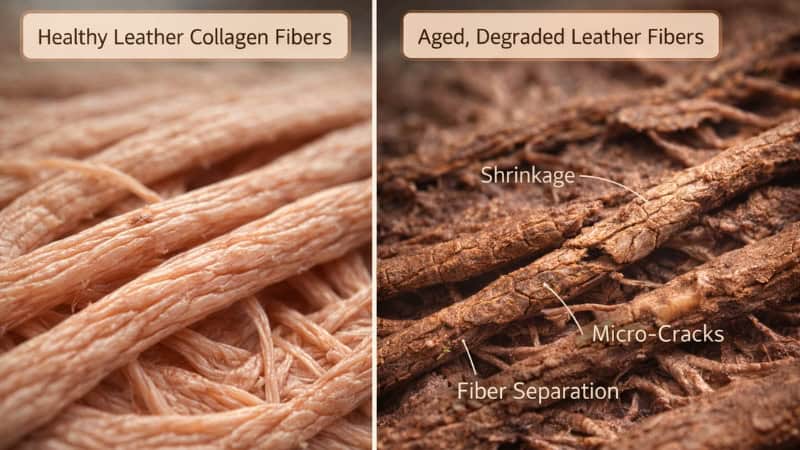
Leather ages because its collagen fiber network gradually loses moisture, undergoes oxidation, and experiences molecular breakdown. Over time, this alters the fiber structure, reducing elasticity, tensile strength, and flexibility.
At a microscopic level, leather is a stabilized biological material made from the dermis layer of animal hide, primarily composed of interwoven collagen fibers. Aging disrupts this fibrous architecture.
The result? Surface cracking, stiffness, patina formation—or in severe cases—fiber collapse and structural degradation.
Understanding how leather deteriorates at the fiber level helps manufacturers, restorers, and consumers make better decisions about care, storage, longevity, and restoration.
What Is the Fiber Structure of Leather?
Leather’s performance depends entirely on its internal collagen fiber structure. These fibers form a three-dimensional, interwoven matrix that gives leather its strength, flexibility, and durability.
Unlike synthetic materials, leather is not uniform. Its structure varies by layer, tanning method, and fiber density.
The Role of Collagen Fibers in Leather
Collagen is a triple-helix protein arranged into fibrils and bundled into larger fiber networks.
- Grain Layer: Dense, tightly packed collagen fibers aligned parallel to the surface. This layer determines strength and abrasion resistance.
- Corium Layer: Looser fiber bundles arranged in a crisscross pattern. This provides flexibility and shock absorption.
- Fiber Orientation: Random yet interlocked architecture distributes stress evenly across the hide.
This hierarchical fiber structure explains why full-grain leather maintains superior durability over time.
How Tanning Stabilizes Leather Fibers
Raw collagen decomposes quickly. The tanning process prevents this by creating chemical cross-links between collagen molecules.
- Vegetable Tanning: Uses plant tannins to form hydrogen and covalent bonds. Produces firm leather with natural patina development.
- Chrome Tanning: Uses chromium salts to create stable cross-linking. Increases flexibility and hydrothermal stability.
- Cross-Linking Stability: The density and type of cross-links determine how resistant leather is to aging, hydrolysis, and oxidation.
Without proper tanning, collagen fibers would shrink, gelatinize, and decay.
Key Insight: Leather aging is essentially the gradual weakening or breakdown of these stabilized collagen cross-links.
The Science of Leather Aging: Step-by-Step Fiber Changes
Leather deterioration is a progressive process involving moisture loss, oxidative stress, chemical instability, and mechanical fatigue.
Moisture Loss and Fiber Shrinkage
Leather contains bound water within its collagen matrix. As it ages:
- Bound water evaporates.
- Fiber bundles contract.
- Elasticity decreases.
- Micro-cracks begin forming at stress points.
Loss of internal moisture makes collagen fibers rigid, leading to stiffness and surface cracking.
This is why improperly stored leather becomes brittle.
Oxidation of Collagen Fibers
Oxygen and UV radiation trigger oxidative degradation.
- UV breaks peptide bonds in collagen.
- Oxidation alters molecular structure.
- Fibers become brittle and discolored.
- Darkening or yellowing may occur.
Prolonged sunlight exposure accelerates this process, especially in vegetable-tanned leather.
Breakdown of Cross-Links
Over decades, tanning cross-links weaken.
- Hydrolysis disrupts collagen bonding.
- Chromium or tannin stability reduces.
- Shrinkage temperature drops.
- Tensile strength declines.
As cross-links deteriorate, fiber bundles separate, reducing structural cohesion.
Mechanical Fatigue from Repeated Use
Daily flexing compresses and stretches fiber bundles.
- Repeated bending causes fiber fracture.
- Creases form where fibers compact.
- Stress concentration weakens structural integrity.
This explains why leather shoes crease at the vamp and leather seats crack at pressure points.
Internal vs External Aging Factors Affecting Leather Fiber Structure
Leather aging depends on both intrinsic composition and environmental exposure.
Internal Factors
- Tanning Method: Chrome-tanned leather typically resists hydrothermal degradation better than vegetable-tanned.
- Fatliquoring Content: Oils lubricate fibers; low oil content accelerates brittleness.
- Fiber Density: Full-grain leather has denser collagen networks.
- pH Level: Acidic conditions promote red rot and collagen hydrolysis.
Internal composition defines baseline durability.
External Environmental Factors
- Humidity Fluctuations: Rapid drying causes shrinkage stress.
- High Temperature: Accelerates oxidative reactions.
- UV Radiation: Breaks collagen peptide chains.
- Air Pollution: Sulfur dioxide increases acid hydrolysis.
- Improper Storage: Plastic wrapping traps moisture and alters pH.
Professional Standard: Museums maintain 40–55% relative humidity to prevent collagen degradation.
Visible Signs of Fiber Structure Aging in Leather
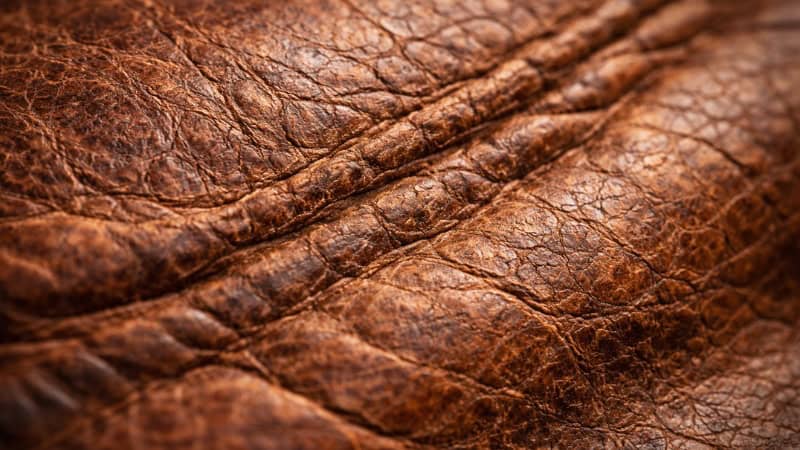
Structural aging manifests visibly once fiber integrity declines.
Surface Cracking & Grain Damage
Cracking begins when contracted collagen fibers lose flexibility. Grain layer splits appear at flex zones.
Loss of Flexibility
Rigid fiber bundles resist bending, resulting in stiffness and creasing.
Red Rot (Acidic Degradation)
Common in antique vegetable-tanned leather.
- Acid hydrolysis breaks collagen.
- Fibers disintegrate into powder.
- Structural failure becomes irreversible.
Patina vs Structural Damage
Patina is surface oxidation and oil redistribution—cosmetic and often desirable.
Fiber collapse, however, indicates internal structural decay.
Understanding the difference prevents misdiagnosing healthy aging as damage.
Microscopic Changes in Aged Leather (Scientific Perspective)
Under Scanning Electron Microscopy (SEM), aged leather reveals measurable structural changes.
- Fiber bundle separation increases.
- Collagen fibrils appear fragmented.
- Porosity rises.
- Shrinkage temperature declines due to weakened cross-links.
Hydrothermal stability testing confirms that aged leather shrinks at lower temperatures, indicating compromised molecular integrity.
These findings are standard in ISO leather testing protocols used by material scientists and conservation labs.
Differences in Aging: Vegetable-Tanned vs Chrome-Tanned Leather
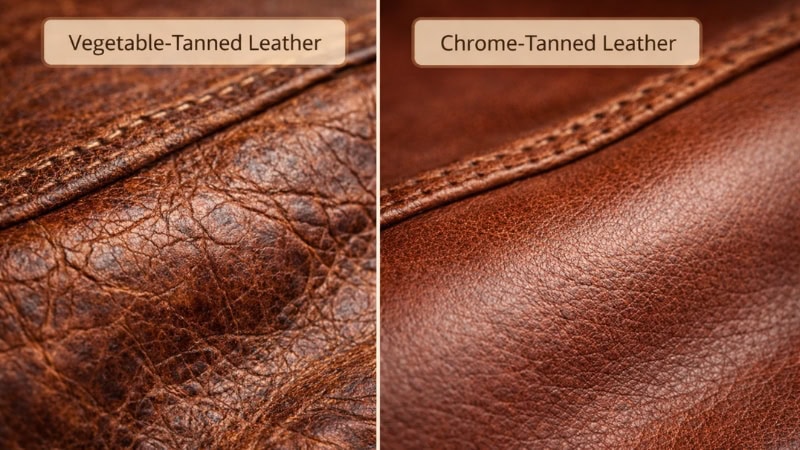
Vegetable-tanned and chrome-tanned leather age differently because their collagen cross-linking chemistry differs fundamentally.
Vegetable-Tanned Leather Aging Pattern
Vegetable tanning relies on plant-derived tannins forming hydrogen and covalent bonds with collagen fibers.
Over time:
- Oxidation darkens the surface
- Cross-links gradually weaken
- Fiber rigidity increases
- Susceptibility to acid hydrolysis rises
Vegetable-tanned leather develops rich patina and character. However, it is more vulnerable to long-term brittleness, especially under fluctuating humidity and acidic conditions.
Red rot is primarily associated with aged vegetable-tanned leather due to progressive pH imbalance.
Chrome-Tanned Leather Aging Pattern
Chrome tanning uses chromium (III) salts to create stable coordination bonds with collagen.
This results in:
- Higher hydrothermal stability
- Greater resistance to moisture-related shrinkage
- Improved flexibility over time
- Lower susceptibility to red rot
Chrome-tanned leather typically retains softness longer and resists oxidative brittleness better than vegetable-tanned alternatives.
However, prolonged environmental stress can still reduce tensile strength and degrade fiber cohesion.
Which Ages Better?
From a structural standpoint, chrome-tanned leather generally demonstrates superior long-term stability under harsh environmental conditions.
From an aesthetic standpoint, vegetable-tanned leather ages more visibly and develops a desirable patina.
The choice between them depends on whether the priority is structural durability, visual aging, or archival longevity.
Understanding these fiber-level differences allows buyers, restorers, and manufacturers to predict aging trajectories more accurately.
Can Aging Be Slowed? Preventing Fiber Degradation
Aging cannot be stopped, but fiber degradation can be significantly slowed.
Conditioning and Rehydration
Conditioners replenish oils lost through evaporation.
- Restores fiber lubrication.
- Reduces friction between collagen bundles.
- Prevents shrinkage cracking.
Avoid over-conditioning, which can oversaturate fibers.
Controlled Storage
Maintain stable humidity between 40–55%.
Avoid direct sunlight and heat sources.
Store in breathable fabric bags—not plastic—to preserve moisture equilibrium.
UV Protection
UV-blocking storage and shaded placement reduce oxidative collagen damage.
Practical Experience: Proper conditioning doubles the usable lifespan of frequently flexed leather goods.
Is Aged Leather Always Weaker?
Aged leather is not automatically structurally compromised. Cosmetic aging and molecular degradation are not the same process.
Leather can develop patina—a surface-level oxidation effect that deepens color and enhances visual appeal—without significant internal fiber damage. In high-quality full-grain leather, dense collagen networks may remain structurally sound even after decades.
However, when aging progresses to cross-link degradation, fiber bundle separation, and shrinkage temperature reduction, tensile strength declines measurably. The leather may appear intact but feel stiff, brittle, or fragile under flex stress.
Functional strength depends on:
- Collagen cross-link integrity
- Moisture equilibrium
- Fiber density
- Environmental exposure history
Vintage leather can remain durable if properly maintained. Conversely, poorly stored leather may lose structural resilience within years.
The distinction lies in fiber condition—not chronological age.
Restoration of Aged Leather Fiber Structure
Restoring aged leather is not about reversing time—it is about stabilizing collagen fibers, slowing further degradation, and improving flexibility. Once collagen denatures or cross-links permanently break, true structural regeneration is scientifically impossible. However, targeted conservation methods can significantly extend usability.
Reconditioning Treatments: Lubrication of Collagen Fiber Bundles
Leather loses internal lubricants (fatliquors) as it ages. Without lubrication, collagen fibrils rub against each other, increasing brittleness.
Conditioning works by:
- Replenishing lost oils that sit between fiber bundles
- Reducing internal friction within the collagen matrix
- Improving flexibility and surface resilience
High-quality conditioners restore suppleness but do not rebuild broken peptide bonds. Over-application can oversaturate fibers, weakening structural cohesion. Controlled, minimal application aligned with leather type is essential.
pH Stabilization and Acid Neutralization
Vegetable-tanned leather is particularly vulnerable to acid hydrolysis, which lowers pH and accelerates fiber breakdown.
Conservation-grade pH balancing treatments:
- Neutralize acidic residues
- Slow red rot progression
- Protect remaining cross-links
Museums monitor leather pH levels to prevent collagen disintegration. Once red rot begins, treatment focuses on halting progression rather than reversing damage.
Structural Consolidation for Powdering Leather
In severe degradation cases—especially archival or antique leather—fibers begin to powder.
Professional conservators use consolidants that:
- Penetrate weakened fiber networks
- Bind fragmented collagen fibrils
- Prevent further disintegration
This technique is stabilization, not repair. Structural strength cannot be fully restored once collagen denatures.
Expert Insight: The most effective restoration strategy is preventive care before hydrothermal stability declines.
FAQs – Aging Affect on Leather Fiber Structure
Why does leather crack as it ages?
Leather cracks because its collagen fibers lose moisture and internal lubrication over time, causing shrinkage and reduced elasticity. As oxidative degradation and hydrolysis weaken the tanning cross-links, the grain layer becomes rigid and cannot flex evenly under stress. Repeated bending then concentrates strain in dry zones, leading to visible surface fractures and structural micro-cracking.
Does real leather deteriorate over time?
Yes, real leather naturally deteriorates because it is made from biological collagen fibers that gradually undergo oxidation, moisture loss, and molecular breakdown. Even stabilized through tanning, collagen remains vulnerable to UV radiation, fluctuating humidity, and acidic environments. Proper storage and conditioning significantly slow deterioration but cannot stop aging entirely.
Can dried leather be fully restored?
Dried leather cannot be fully restored at the molecular level because broken collagen peptide bonds and denatured fibers cannot regenerate. However, conditioning treatments can replenish lost oils, reduce internal fiber friction, and restore flexibility if structural integrity remains intact. Once fiber fragmentation or red rot begins, only stabilization—not reversal—is possible.
What causes red rot in leather?
Red rot is caused by acid hydrolysis in vegetable-tanned leather, where low pH conditions progressively break down collagen cross-links. Environmental pollutants, sulfur compounds, and long-term humidity imbalance accelerate this degradation. As collagen fibers disintegrate, the leather surface becomes powdery and structurally unstable, making the damage irreversible once advanced.
Is full-grain leather more resistant to aging?
Yes, full-grain leather is generally more resistant to aging because it retains the densest and most intact collagen fiber network from the grain layer. This tightly interwoven structure provides higher tensile strength, improved resistance to mechanical fatigue, and slower degradation compared to corrected or bonded leather, which have altered or fragmented fiber architectures.
Does sunlight permanently damage leather fibers?
Yes, prolonged exposure to sunlight causes photo-oxidation, which breaks down collagen peptide chains and weakens tanning cross-links. This reduces flexibility, darkens the surface, and lowers hydrothermal stability. UV damage accumulates gradually and cannot be reversed, making sunlight protection essential for preserving fiber structure.
How does humidity affect leather fiber structure?
Humidity directly influences collagen stability because leather contains bound water within its fiber matrix. Low humidity causes fiber shrinkage and brittleness, while excessive humidity promotes hydrolysis and mold growth. Repeated fluctuations between dry and moist conditions stress the collagen network, accelerating structural fatigue and deterioration.
How long does leather typically last before structural breakdown?
High-quality full-grain leather stored under stable indoor conditions can maintain structural integrity for 30 to 50 years or longer. However, exposure to UV radiation, high heat, acidic pollutants, or poor humidity control can significantly shorten this lifespan. Environmental stability plays a greater role in longevity than chronological age alone.
Is patina a sign of damage?
No, patina is primarily a surface-level oxidation and oil redistribution process that enhances color depth and character without necessarily weakening internal collagen fibers. Structural damage occurs only when fiber cohesion declines or cross-links deteriorate, whereas patina reflects aesthetic aging rather than mechanical failure.
Can leather aging be scientifically measured?
Yes, leather aging can be objectively measured using shrinkage temperature testing, tensile strength analysis, pH evaluation, and scanning electron microscopy. A decline in hydrothermal stability or tensile strength indicates weakened collagen cross-links and fiber degradation. These standardized material science methods are widely used in leather research and conservation laboratories.
Key Takeaways
Leather aging is a molecular process involving collagen fiber degradation, moisture loss, oxidation, and cross-link breakdown. Tanning method, environmental exposure, and maintenance determine how fiber structure evolves over time.
Patina is cosmetic; fiber collapse is structural.
With controlled humidity, UV protection, and conditioning, leather’s functional lifespan can extend for decades. Understanding fiber science transforms how we preserve, purchase, and evaluate leather products.
